Single-component, water-based peelable film system for radioactive dust suppression, fixation, and mechanical decontamination recovery. Engineered for nuclear incident response and radiological contamination control.
Tested against 32P radioactive fallout simulant per enterprise standard test method. All values at application density 0.6–2.5 m²/L on flat pavement or hard surfaces.
All values at standard conditions unless noted. Dual units shown: metric (SI) / US customary.
| Parameter | Value (SI / Metric) | Value (US Customary) |
|---|---|---|
| — Physical Properties — | ||
| Product State | Homogeneous aqueous emulsion | Single-component; no mixing required |
| Dynamic Viscosity | 1,300 – 1,400 mPa·s | 1,300 – 1,400 cP |
| Tensile Strength | ≥ 2.0 MPa (ASTM D412) | ≥ 290 psi |
| Tear Strength | ≥ 10 kN/m (ASTM D624) | ≥ 57 lbf/in |
| Break Strength | ≥ 0.8 MPa | ≥ 116 psi |
| Peel Force (from substrate) | ≤ 1 N | ≤ 0.22 lbf |
| — Cure / Film Characteristics — | ||
| Film Formation Time | ≤ 2 hours @ 25°C, ventilated | ≤ 2 hours @ 77°F |
| Surface Dry Time | ≤ 4 hours @ 25°C, ventilated | ≤ 4 hours @ 77°F |
| Continuous Peel Window | ≤ 8 hours @ 25°C, ventilated | ≤ 8 hours @ 77°F |
| Film Mechanical Stability | Maintains recovery specs for ≥ 2 months | Compatible with mechanized film recovery vehicles throughout |
| — Application Parameters — | ||
| Coverage Rate | 0.6 – 2.5 m²/L | 5.9 – 24.4 ft²/L |
| Application Rate (local decon) | 0.5 – 1.0 kg/m² | 0.10 – 0.20 lb/ft² |
| Operating Temperature | 5°C – 40°C | 41°F – 104°F |
| Operating Relative Humidity | ≤ 80% RH | ≤ 80% RH |
| Long-term Use Temperature | –10°C to +50°C | 14°F to 122°F |
| — Safety & Compliance — | ||
| Flammability | Non-flammable | Non-flammable |
| Toxicity | Non-toxic · Non-irritant | No PPE above standard nuclear protocol required |
| Corrosivity | Non-corrosive to equipment | Safe for metals, polymers, spray vehicle internals |
| Secondary Contamination | Zero secondary contamination | Radionuclides encapsulated within peeled film |
| — Packaging & Storage — | ||
| Package Size | 50 kg / plastic drum | 110 lb / drum · approx. 13.2 US gal |
| Shelf Life | 24 months from manufacture date | 2 years; use within shelf life for rated performance |
| Storage Conditions | 5°C – 30°C, sealed, dark, dry | 41°F – 86°F; protect from UV and moisture |
| Spray Equipment Compatibility | Homogeneous emulsion — no clogging | Compatible with standard radioactive decon spray vehicles |
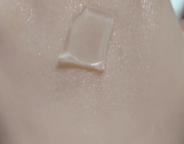
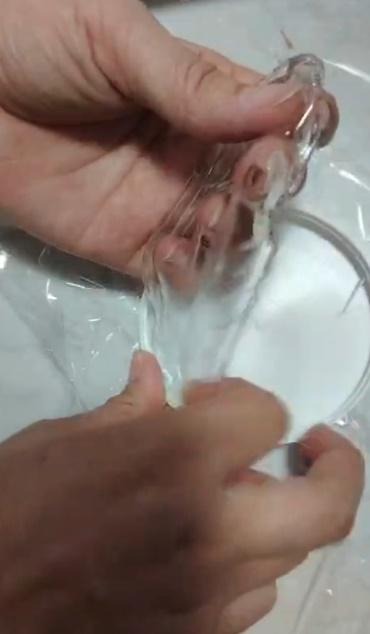
The following photographs document film formation characteristics and peel behavior under laboratory conditions, demonstrating the mechanical properties specified in the technical data above.
IAS-SDC-50 uses a water-dispersed high-molecular-weight polymer system with chelating agent enhancement to immobilize and extract radionuclides from contaminated surfaces.
The aqueous emulsion is applied by standard radioactive decontamination spray vehicle at a coverage rate of 0.6–2.5 m²/L. The homogeneous formulation ensures no nozzle clogging. On contact, the liquid immediately penetrates the surface layer and begins fixating airborne radioactive dust particles.
As the film forms, specific functional groups on the polymer chains — combined with the chelating additive — create physical-chemical bonds with radioactive nuclides including organic radioiodine (131I) and noble gas species. Radionuclides are drawn from the substrate surface into the forming film matrix, preventing re-suspension and lateral migration.
The polymer network cross-links naturally at ambient temperature. Film formation is complete within 2 hours; surface is dry-to-touch within 4 hours. The cured film achieves tensile strength ≥2.0 MPa and tear strength ≥10 kN/m, enabling clean mechanical recovery without film fracture on smooth, hard surfaces.
Within the 8-hour continuous peel window, the film is recovered using a film recovery vehicle. The peel force from the substrate is ≤1 N, ensuring clean separation without substrate damage. Radionuclides remain encapsulated within the recovered film, eliminating secondary contamination. The film maintains mechanical integrity for ≥2 months, allowing deferred recovery if needed.
In areas with high radionuclide loading, multiple sequential applications achieve a cumulative surface decontamination factor ≥95%. Each cycle removes an additional fraction of residual surface contamination. The coating also provides temporary shielding against α/β radiation penetration during the peel window.
Water-based formulation with no hazardous solvents. Radionuclides are encapsulated within the recovered film — zero dispersal to surrounding environment.
Chelating additives create selective high-affinity bonds with radioactive metallic cations, significantly increasing nuclide uptake efficiency versus non-chelated film systems.
Film tensile and tear strength are specifically engineered to resist breaking during roll-up by film recovery vehicles on flat or paved surfaces. Continuous film sheets = no fragment contamination.
Application thickness is operator-controlled. Increase coating depth for α emitters (which require greater film mass for self-shielding); reduce for β/γ-dominated contamination scenarios.
Application window 5°C–40°C (41°F–104°F). Long-term use from –10°C to +50°C (14°F to 122°F). No performance degradation across the operational range.
Homogeneous emulsion state eliminates spray nozzle clogging. Non-corrosive to metals, rubbers, and polymers used in standard nuclear response vehicles and equipment.
IAS-SDC-50 is designed in alignment with the following international standards and regulatory frameworks.
Our nuclear applications team can advise on application rates, equipment compatibility, and logistical requirements for your specific deployment scenario.