How Our Multi-Stage Filtration
Works
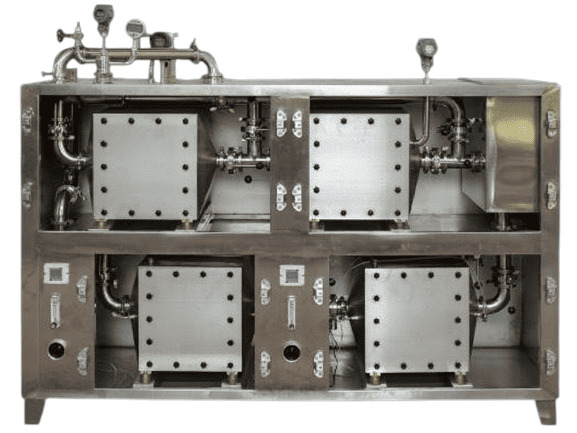
A HEPA filter on its own takes the full dust load and clogs fastest, and it cannot remove radioiodine or gases. Our units combine up to three stages: a washable metal-foam pre-filter, a HEPA filter, and impregnated activated carbon where radioiodine or gases must be removed. All three are physical or adsorptive processes: contaminants are captured and held, not destroyed.
A HEPA filter alone clogs fastest with coarse dust, and it does nothing for radioiodine or gases. Our units put a washable metal-foam pre-filter in front of the HEPA filter to extend its life, and add impregnated activated carbon where radioiodine or gases must be removed. Filtration captures pathogens but does not kill them, so used filters are always handled with bagging and PPE. Contact our engineering team: or sales@iodineairsystems.com.
// Custom-engineered for each facility — parameters below are design targets
Filtration mechanism = Metal-foam pre-filter + HEPA + optional impregnated activated carbon
Particulate efficiency = ≥99.97% at 0.3 μm (HEPA grade)
Pre-filter = Open-cell metal foam, washable and reusable
Adsorption targets = Radioiodine (I₂, CH₃I) · selected gases and odors
Adsorbent = Impregnated activated carbon
Documentation = Third-party whole-unit test (report KJ2026002491) · certificate of conformance · designed to project specification
Installation type = Bespoke HVAC integration · custom ductwork matching
MERV rating = Engineered to application requirements // MERV 13–16 or HEPA/ULPA
Monitoring = Built-in differential pressure gauges; transmitters and alarms on request
Service interval = Application-dependent // hospital 6–12 mo · nuclear per NRC schedule
Critical Facilities
We Protect
Every facility has a unique contaminant profile, airflow architecture, and regulatory compliance requirement. Iodine Air Systems engineers each installation from first principles — no off-the-shelf units, no compromised specifications.
Air Purification System Sizing Calculator
How much air per hour, how many units, how much carbon, what duct diameter and motor kW — plus what your pressure gauge says about changing HEPA and carbon. Send the result to our engineers for a firm quote.
Open the calculator → When to change filters →- ▸ Airflow in CFM & m³/h from room size + ACH
- ▸ Units: IAS-NC700-HI / IAS-NC500-HI-CUSTOM
- ▸ Carbon bed volume, beds & 50 L drums
- ▸ Duct diameter, fan pressure, motor kW / HP
- ▸ HEPA & carbon ΔP change-out check
Tritium Monitors: Portable, Area, Glovebox, HT/HTO and Wipe
Eight tritium monitoring instruments from 0.05 DAC (3.7 × 10⁴ Bq/m³) to 10 Ci/m³, for fusion facilities, heavy-water reactors, DOE laboratories, tritium light manufacturers and system integrators. US 120 V versions, calibration certificates and certificates of conformance. Price on quotation.
Portable Tritium-in-Air Monitor
Portable survey monitorIAS-TA20
Rack-Mount Area Tritium Air Monitor
Fixed area monitor (19-inch rack)IAS-TA30
Floor-Standing Tritium Air Monitor
Fixed area monitor (cabinet)IAS-TG30
Glovebox & Process Tritium Monitor
Process monitor (sealed, all-metal)IAS-TG10
Wall-Mount Process Tritium Detector
Process detector (wall-mount, PLC-ready)IAS-TD20
Tritium Ion Chamber Detector Module (OEM)
OEM detector moduleIAS-TS40
HT / HTO Tritium Speciation Monitoring System
Multi-form (HT/HTO) monitoring systemIAS-TW10
Tritium Surface Contamination (Wipe) Monitor
Surface contamination / wipe monitor
See all tritium monitors and build a quote → · How to choose · Fusion guide · Tritium DAC converter · ZrCo tritium purification beds
A $53 Billion Market
With One Unsolved Problem
The global air purification systems market is valued at $28.99 billion in 2025 and growing to $53.66 billion by 2033 at a CAGR of 7% (Straits Research). The air filters segment is $16 billion in 2024 growing to $29.1 billion by 2032. North America leads with a 37.38% global market share. Yet the majority of this market is served by passive filtration products that take the full dust load on the HEPA stage and cannot remove radioiodine or gases. Multi-stage units with a reusable pre-filter and carbon stages address that gap.
In July 2026, the U.S. Department of Energy's Reactor Pilot Program achieved four advanced reactor designs reaching criticality — Antares' Mark-0, Valar Atomics' Ward 250, Deployable Energy's Unity, and Aalo Atomics' Aalo-X — exceeding the White House's three-reactor target ahead of schedule (DOE, July 2026). In August, Oklo's Groves isotope test reactor in Texas became the fifth (DOE, August 2026). Each new reactor site brings fresh demand for nuclear-grade HEPA/ULPA and radioiodine adsorber filtration. Iodine Air Systems designs these systems to EJ/T 20088-2014 and works with qualified partners to complete ASME AG-1 related qualification where a project requires it.
The NRC holds its hearing on Eden Radioisotopes' New Mexico complex, which is designed to produce Mo-99, I-131 and Xe-133, on September 29, 2026; China approved eight more reactors; and the NRC proposed a broad overhaul of reactor regulations. Read the full September 2026 market update →
Nuclear-grade radioiodine activated carbon (adsorber elements and bulk), HEPA elements, pre-filters, ducting and decon coating — by part number, with quotes FOB or CIF. Order replacement parts →
Every Standard.
Every Industry.
Critical facility air quality is not advisory — it is legally mandated. Non-compliance carries regulatory penalties, operational shutdowns, and liability exposure. Iodine Air Systems designs each unit to the specification your engineer sets for the facility, and supplies the test reports to document it.
North American
Critical Infrastructure Focus
United States — World's Largest Critical Infrastructure Market (37.38% global share)
The US dominates global industrial air purification procurement. Key drivers: 6,093 hospitals, 58 nuclear power plants (93 reactors), 14,000+ EPA-regulated industrial facilities, and the world's largest government/defense facility network. ASHRAE 241 (2023) created a new compliance mandate for all US commercial buildings. OSHA enforcement actions for chemical PEL violations exceeded $200M in 2024. The US Bipartisan Infrastructure Law allocated $65B for critical infrastructure — significant portion for facility upgrades including air quality systems. Primary procurement channels: federal GSA schedules, hospital group purchasing organizations (GPOs), industrial EPC firms. Iodine Air Systems is headquartered in the US and serves all 50 states.
Canada — World-Class Nuclear Fleet, Stringent Environmental Standards
Canada operates 19 CANDU nuclear reactors (6 plants), regulated by the Canadian Nuclear Safety Commission (CNSC). Canada's healthcare sector (1,200+ hospitals) follows similar standards to US CDC/FGI with provincial health authority oversight. Chemical industry concentrated in Alberta (oil sands, petrochemical) and Ontario (manufacturing corridor). Health Canada and Environment and Climate Change Canada drive air quality standards. CNSC regulatory framework for nuclear facility ventilation aligns with NRC standards. Iodine Air Systems supplies Canadian critical infrastructure and provides the product test reports and documentation your CNSC submission needs.
Europe — EN Standards, REACH Compliance, Largest Nuclear Fleet Outside Asia
Europe operates 103 nuclear reactors across France, Germany (phase-out), UK, and Eastern Europe. The EU Industrial Emissions Directive (IED) and REACH regulation drive chemical facility air quality investments. EU healthcare facilities follow EN 13779 (ventilation) and EN 1822 (HEPA/ULPA test standards). France has the world's highest nuclear energy dependency (70%+ electricity from nuclear). Germany is decommissioning nuclear but upgrading remaining industrial air quality infrastructure. UK maintains rigorous HSE standards for chemical and nuclear facilities. European air purification market expected 6.97% CAGR through 2032 — fastest growing region.
Asia-Pacific — Fastest Growing Market (9.1% CAGR), Nuclear Expansion
APAC leads global air purification growth at 9.1% CAGR through 2030. China operates 55 nuclear reactors with 20+ under construction — the world's fastest nuclear expansion. Japan's post-Fukushima regulatory framework (NRA) mandates advanced filtration for all nuclear facilities. South Korea operates 26 reactors with strict KINS oversight. India is expanding its pharmaceutical manufacturing sector (world's 3rd largest) — cleanroom and GMP air quality systems are high demand. Singapore's data center density (40% of Southeast Asian data center capacity) creates significant demand for precision air quality systems. Iodine Air Systems provides English-language technical documentation and can coordinate regional installation partnerships.
Middle East & Gulf — Nuclear Buildout, Petrochemical Capital, Healthcare Expansion
The Middle East is entering a major industrial air quality investment cycle. UAE's Barakah nuclear plant (4 reactors, Arab world's first) requires comprehensive filtration systems meeting FANR (Federal Authority for Nuclear Regulation) standards. Saudi Arabia's NEOM megaproject and Vision 2030 include world-class hospital networks requiring advanced HVAC air quality. The Gulf petrochemical industry (world's largest concentration of processing facilities in Saudi Arabia, Kuwait, Qatar) creates massive demand for chemical gas filtration. Qatar's LNG infrastructure — the world's largest — requires specialized industrial air treatment. Iodine Air Systems designs units to the project specification, including IEC, ISO and GCC requirements where they apply.
Standards and
References
Engineering
Questions Answered
Three differences: (1) Washable metal-foam pre-filter: it takes the coarse dust load, so the HEPA filter lasts longer and less filter waste is created. (2) Optional activated carbon: impregnated carbon adsorbs radioiodine and selected gases that HEPA cannot capture. (3) Custom engineering and built-in testing: units are built to your airflow and space, with differential pressure gauges and HEPA test ports. Like any HEPA filter, ours captures pathogens but does not kill them. Contact: or sales@iodineairsystems.com.
Our installation process: (1) Facility assessment: Our engineers conduct a comprehensive airflow analysis, contaminant profile assessment, and regulatory compliance audit of your existing HVAC system. (2) System design: Custom filter housing and media specifications are engineered to match your ductwork dimensions, CFM requirements, and target filtration efficiency. (3) Minimal-disruption installation: Most installations can be completed during planned maintenance windows. Hospital installations are scheduled with your facilities team to minimize operational disruption. (4) Commissioning and testing: Post-installation air quality testing and compliance documentation for your regulatory authority. (5) Ongoing support: scheduled maintenance programs, filter change-out and carbon testing. Contact: sales@iodineairsystems.com.
Yes. The metal-foam pre-filter and HEPA filter are mechanical filters and release nothing into the air. Impregnated activated carbon is used in enclosed filter stages downstream of the HEPA filter or in dedicated adsorber units, mainly for nuclear and nuclear medicine applications. For specific safety documentation for your project, contact our engineering team at sales@iodineairsystems.com.
Our consultation process is structured to deliver a complete specification in 5–10 business days: Day 1–2: Initial call to understand your facility type, size, current HVAC specifications, regulatory compliance requirements, and primary contaminant concerns. Day 3–5: Engineering review of facility documentation (HVAC drawings, existing air quality test data, regulatory compliance reports). Day 6–8: System specification development — filter media selection, housing design, integration approach, CFM calculations. Day 9–10: Written proposal with engineering specifications, compliance documentation strategy, and installation timeline. Contact us to begin: or sales@iodineairsystems.com.