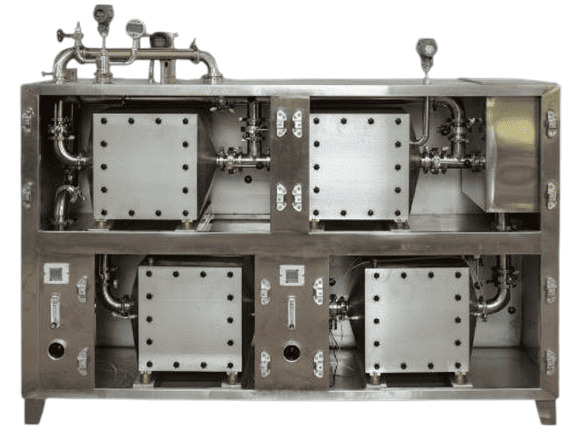
I-131 Challenges in Hospital Nuclear Medicine Departments
Iodine-131 (¹³¹I) presents particularly acute ventilation challenges in hospital environments due to its 8-day physical half-life, high volatility, and biological concentration in the thyroid gland. When patients receive I-131 therapy for thyroid ablation or thyroid cancer treatment, significant radioactive iodine concentrations are continuously exhaled through respiration, perspiration, and body secretions — creating substantial airborne contamination in therapy rooms that persists for days.
Unlike traditional chemical hazards that remain relatively static, I-131 volatilization increases with patient body temperature, activity level, and room humidity. A single high-dose therapy patient (100+ mCi administered activity) can exhale ¹³¹I at concentrations far exceeding safe limits for healthcare workers in adjacent rooms, creating a dynamic and persistent contamination hazard that standard hospital HVAC cannot address.
Why Standard Hospital Ventilation Is Insufficient
Standard hospital HVAC systems — even those meeting ASHRAE 170 infection control requirements — cannot adequately contain radioactive iodine vapor. They lack:
- Iodine-specific adsorption: Standard HEPA filters do not capture iodine vapor; only impregnated activated carbon does.
- Precise negative pressure: Standard hospital systems lack the calibrated differential pressure monitoring required by NRC.
- Continuous documentation: NRC requires tamper-proof recording of pressure, airflow, and filter status — not standard in typical HVAC controls.
- Redundant containment: Backup filtration trains and emergency power are required for high-dose therapy facilities.
Inadequate I-131 ventilation can result in: staff radiation doses exceeding NRC occupational limits (50 mSv/year); contamination of adjacent patient rooms; regulatory action under NRC 10 CFR 35; and potential facility license suspension. Do not operate I-131 therapy without a validated ventilation system.
Regulatory Framework: NRC Requirements for Hospital Nuclear Medicine
Hospital nuclear medicine departments administering I-131 therapies operate under a multi-agency regulatory framework. The primary federal authority is the U.S. Nuclear Regulatory Commission (NRC), with supplemental guidance from NFPA, ASHRAE, and state radiation control programs (which may be more stringent than federal requirements).
NRC 10 CFR 35.75 — The Primary Regulation
NRC 10 CFR 35.75 governs the release of individuals containing unsealed byproduct material, including patients who have received I-131. It mandates that licensees implement appropriate engineering controls to ensure released patients do not cause radiation exposures to members of the public exceeding 5 mSv (0.5 rem) total. This requirement drives the need for validated therapy room ventilation systems.
| Regulation / Standard | Requirement | Applicability |
|---|---|---|
| NRC 10 CFR 35.75 | Primary engineering controls for ¹³¹I release | All NRC-licensed I-131 therapy facilities |
| NRC 10 CFR 20 (Subpart D) | Radiation exposure limits: 50 mSv/yr occupational, 1 mSv/yr public | All NRC licensees |
| ASHRAE 170-2021 | Nuclear medicine: 6 ACH minimum, all-exhaust (100% outside air) | New construction and major renovation |
| NFPA 99 (2024 ed.) | Medical gas and ventilation for health care facilities | All health care occupancies |
| ANSI/HPS N13.1 | Air sampling standard for radioactivity | Radioactive air monitoring systems |
| State Radiation Programs | May exceed federal requirements | State-licensed facilities (Agreement States) |
37 U.S. states are "Agreement States" with NRC-equivalent or more stringent radiation control programs. Always verify your state's specific I-131 ventilation requirements with your state radiation control program, as these may impose requirements exceeding federal NRC rules — particularly for negative pressure values and air change rates.
Ventilation Design Guidelines & Quick Reference
Negative Pressure Design
Maintaining continuous negative pressure relative to adjacent areas and the corridor is the primary engineering control for I-131 containment. The minimum NRC-required negative pressure differential is 0.01 inches water gauge (25 Pa), monitored continuously with a tamper-proof recording system that activates an alarm if the differential falls below threshold.
Key design considerations for negative pressure systems:
- Size exhaust fans for sufficient capacity to maintain negative pressure even with door opening transients
- Door undercuts or transfer grilles must be sized to permit the required airflow differential without excessive noise
- Pressure monitoring gauges should be located at the room entrance, visible to staff entering the room
- Emergency power (UPS or generator) must maintain negative pressure in the event of power failure — pressure loss is not permitted to occur even momentarily during fan switchover
Air Change Rate (ACH) Requirements
ASHRAE 170 specifies a minimum of 6 air changes per hour (ACH) for nuclear medicine therapy rooms. For high-dose I-131 therapy facilities (≥100 mCi administered activity, thyroid cancer ablation), 12 ACH is strongly recommended to achieve adequate dilution of exhaled ¹³¹I vapor and to reduce room air activity more quickly between patient treatments.
Filtration Technology: HEPA + Activated Carbon
The I-131 therapy room exhaust filtration train must address two distinct contaminant forms simultaneously: radioactive particulates (contaminated aerosols, skin flakes, body fluid aerosols) and radioactive vapor (¹³¹I gas volatilized from patient exhalation and perspiration). No single filter type captures both effectively.
The Three-Stage Filtration Train
- Pre-filter (MERV 8–13): Captures coarse particulates and protects downstream filters from loading. Extends the service life of the more expensive carbon and HEPA stages. Replace every 1–3 months depending on loading.
- Nuclear-grade impregnated activated carbon: The critical I-131 vapor capture stage. Carbon impregnated with TEDA (triethylenediamine) or potassium iodide reagent achieves ≥99.9% methyl iodide removal at standard test conditions. This is the only media effective against gaseous ¹³¹I.
- Final HEPA (H13 or H14, EN 1822): Captures any residual contaminated particulates that passed through upstream stages. H13 achieves ≥99.95% at MPPS; H14 achieves ≥99.995%. Also serves as a "safety net" in the event of upstream carbon media failure.
| Filter Stage | Target Contaminant | Efficiency | Change Interval |
|---|---|---|---|
| MERV 8–13 Pre-filter | Coarse particulate, aerosols | 40–85% @ 1–10μm | 1–3 months |
| Impregnated Activated Carbon | ¹³¹I vapor (gaseous iodine) | ≥99.9% CH₃I removal | 6–18 months (dose-dependent) |
| H13 HEPA Final Filter | Residual particulate, aerosols | ≥99.95% @ MPPS | Annual or by ΔP |
| H14 HEPA Final Filter | High-dose applications | ≥99.995% @ MPPS | Annual or by ΔP |
Iodine Air Systems' iodine-catalyzed filtration technology uses elemental I₂ to actively oxidize and neutralize airborne chemical and radioactive iodine species — providing an additional layer of protection beyond passive activated carbon adsorption. This is particularly relevant for high-activity therapy patients where carbon beds may approach breakthrough more rapidly. Learn more about our hospital air systems →
Monitoring, Alarms & Emergency Systems
NRC requires continuous monitoring of all critical ventilation parameters with tamper-proof recording and alert systems. Monitoring failures must be documented and ventilation system malfunctions must trigger defined emergency protocols.
- Room differential pressure: Continuous monitoring with alarm at <0.01 in.WG; tamper-proof data logger with printout capability for NRC inspection
- Exhaust airflow velocity: Continuous monitoring at exhaust duct; alarm on flow reduction >10% from setpoint
- Filter differential pressure: Pre-filter, carbon bed, and HEPA stages each monitored for loading; alarm on high ΔP indicating filter change requirement
- Exhaust radioactivity monitor: Real-time continuous air activity monitor on exhaust duct discharge, with alarm setpoint calibrated to regulatory discharge limits
- Emergency power: UPS or generator with automatic transfer to maintain negative pressure and fan operation during power failure; no-break transfer required
- Staff notification: Visual and audible alarms at nursing station, radiation safety officer notification system
Case Study: Metropolitan Medical Center Hospital Renovation
A 750-bed tertiary care facility faced significant NRC compliance challenges with their existing I-131 therapy room ventilation, including inconsistent negative pressure maintenance and documented filter bypass events during high-patient-load periods.
Challenge: Existing system had no carbon filtration, HEPA-only exhaust, inconsistent negative pressure, and no real-time monitoring. NRC inspection identified ventilation as an area of concern during license renewal review.
Intervention: Complete retrofitting to three-stage filtration train (MERV 13 → impregnated activated carbon → H14 HEPA), upgraded exhaust fan system with VFD control, Magnehelic gauge plus electronic pressure monitoring with remote access, redundant fan train, and UPS backup. Implementation completed in 6 months with minimal disruption to clinical operations through phased implementation during off-peak periods.
System Performance Comparison
| System Type | ¹³¹I Vapor Removal | Particulate Capture | NRC Compliance | Monitoring |
|---|---|---|---|---|
| Standard HVAC only | 0% (vapor passes through) | ~25% (standard filters) | ❌ Non-compliant | None |
| HEPA-only exhaust | 0% (HEPA ≠ vapor) | ≥99.95% | ❌ Non-compliant | Filter ΔP only |
| Carbon + HEPA (standard) | ≥99.5% | ≥99.95% | ⚠️ Partially compliant | Requires upgrades |
| IAS Iodine-Catalyzed System | ≥99.9%+ | ≥99.97% | ✅ Fully compliant | Continuous + remote |
Hospital Implementation Best Practices
Phased Implementation for Active Facilities
For existing hospital facilities requiring system upgrades without halting clinical operations, a carefully planned phased approach is essential. Work in collaboration with the radiation safety officer (RSO), facilities management, and clinical staff to identify scheduled maintenance windows and temporarily transfer I-131 patients to alternative rooms during the installation phases.
Stakeholder Engagement
Engage clinical staff, facility managers, and the RSO throughout the design and implementation process. The RSO is the regulatory interface with NRC and should review all engineering designs and acceptance test procedures before installation begins. Clinical nursing staff should be trained on pressure alarm response and emergency procedures before the system goes live.
System Validation Before Clinical Use
Conduct rigorous system validation before any patient use, including:
- Room pressure differential verification at all door positions (closed, opened, with personnel entry)
- Airflow velocity measurement at exhaust grilles (capture velocity verification)
- Carbon adsorber in-place leak test (methyl iodide challenge per ANSI N510)
- HEPA filter in-place DOP/PAO test
- Monitoring system alarm set-point verification and documentation
- Emergency power transfer test — confirm no-break pressure maintenance
Engineering FAQ
What negative pressure is required for an I-131 therapy room?
NRC 10 CFR 35.75 guidance requires a minimum negative pressure of 0.01 inches water gauge (25 Pa) relative to adjacent areas and the building exterior. This differential must be maintained continuously. Some state programs require higher differentials (0.03 in.WG in several Agreement States). The monitoring system must include a tamper-proof data recorder and audible/visual alarm when pressure drops below threshold. Contact your state radiation control program for jurisdiction-specific requirements.
How many ACH are required for I-131 therapy rooms?
ASHRAE 170 specifies a minimum of 6 air changes per hour (ACH) for nuclear medicine therapy rooms, all exhausted (no recirculation). For high-dose therapy rooms (≥100 mCi administered ¹³¹I), 12 ACH is strongly recommended to achieve adequate dilution of exhaled radioiodine and to reduce room clearance time between patient treatments. Higher ACH also reduces the carbon adsorber's instantaneous loading, extending carbon bed service life.
Can a standard HEPA filter capture I-131?
No. Standard HEPA filters (including H13/H14) capture particulate matter at ≥99.95%+ efficiency — but they have zero efficiency against iodine vapor, which is the primary form of ¹³¹I in a therapy room. Gaseous ¹³¹I passes directly through HEPA media. Only impregnated activated carbon effectively captures iodine vapor. A compliant I-131 filtration system must include both carbon adsorption (for vapor) and HEPA filtration (for contaminated particulates).
How often should the activated carbon filter be replaced?
Carbon adsorber change intervals for I-131 therapy room exhaust are determined by cumulative radioactive loading (total activity exhausted through the bed) and bed depth, not by time alone. Typical intervals range from 6 to 18 months for moderately active therapy facilities. Carbon beds must be replaced before activity breakthrough occurs — monitored by exhaust radioactivity monitoring. The RSO should track cumulative patient treatment activities and consult with the system manufacturer for facility-specific carbon change intervals. Replaced carbon beds are managed as low-level radioactive waste.
What is the difference between H13 and H14 HEPA filters for I-131 applications?
H13 (EN 1822) achieves ≥99.95% efficiency at the most penetrating particle size (MPPS, typically 0.2–0.3 μm); H14 achieves ≥99.995%. For most hospital I-131 therapy room applications, H13 is adequate — the carbon adsorber upstream removes the radioactive iodine vapor, leaving the HEPA to capture any residual contaminated particulates at very low concentrations. H14 is recommended for high-activity facilities (frequent ≥200 mCi treatments) or facilities with multiple therapy rooms exhausting to a common filtration train, where the additional margin of H14 over H13 provides meaningful risk reduction.
Need a Compliant I-131 Ventilation System?
Iodine Air Systems engineers custom iodine-catalyzed filtration for hospital nuclear medicine departments. NRC 10 CFR 35.75 compliant · ASHRAE 170 · H14 HEPA · Continuous monitoring included.