Home › Blog › IAS-NC900-HI Custom Nuclear Air Purification Cart
Production Notes · November 2026
IAS-NC900-HI Custom nuclear air purification cart: two units in final assembly
Fresh off the assembly floor: our IAS-NC900-HI Custom mobile air purification cart for nuclear controlled areas — a customer-specified build of our IAS-NC cart line, rated 1,500 m³/h in a 304 stainless-steel housing, with remote start, radiation monitoring and digital pressure alarms.
November 5, 2026Iodine Air Systems3 min read
Quick answer
The IAS-NC900-HI Custom is a mobile nuclear air purification cart built to one customer’s specification, rated at 1,500 m³/h (about 880 CFM, 900 CFM class). The body is 304 stainless steel. This order carries the smart package: remote start, a variable-frequency drive for airflow, radiation probes before and after the filter (gamma dose-rate alarm above 250 µSv/h, with historical data logging), and a digital differential-pressure meter that alarms when the pressure drop passes 400 Pa. Two units from one production run were in final assembly on November 5, 2026, bound for a nuclear facility’s controlled area.
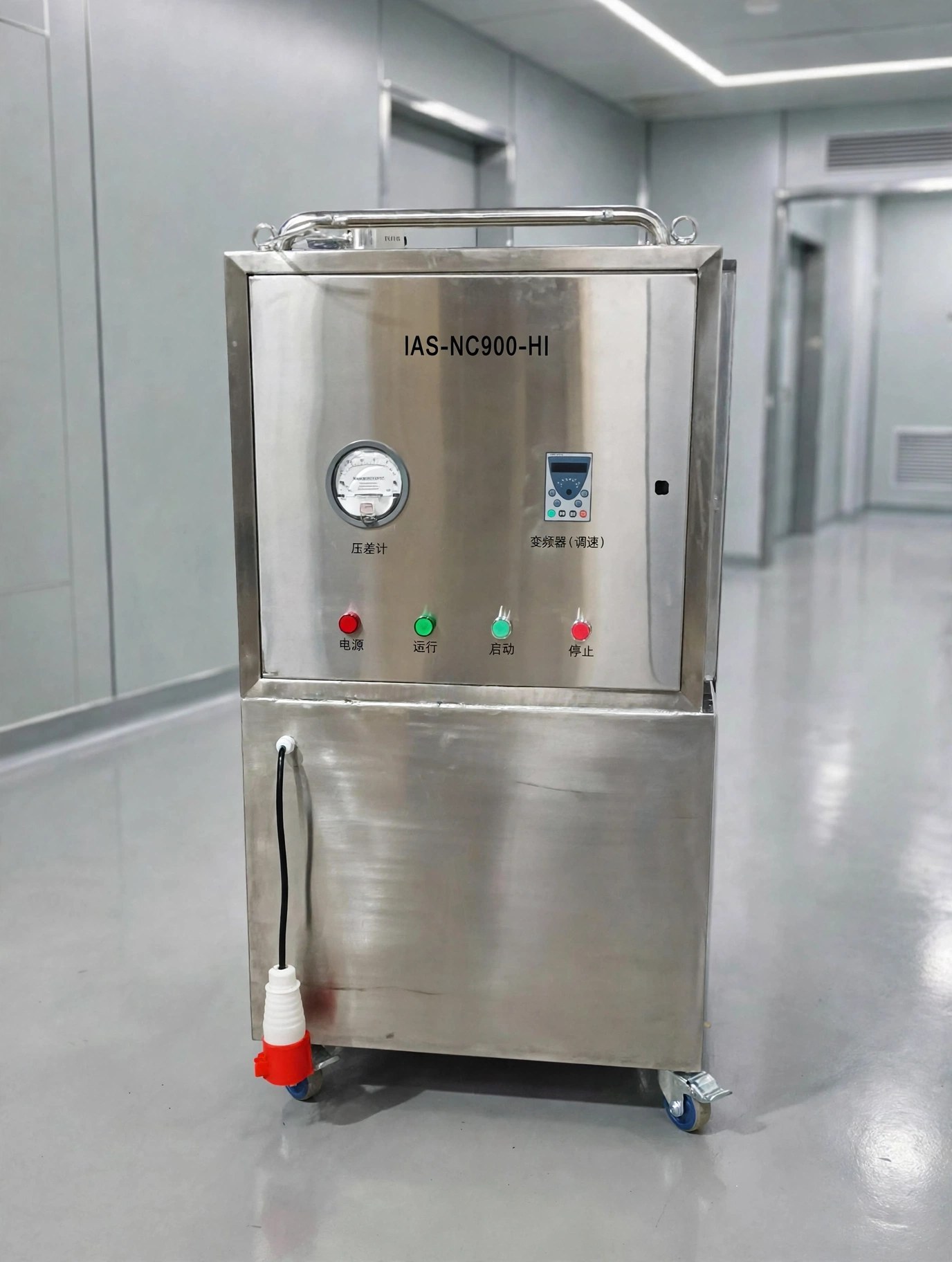
IAS-NC900-HI Custom in final assembly. The panel layout: differential pressure gauge (left), variable-frequency drive controller (right), power / run / start / stop controls below.
What the IAS-NC900-HI Custom is built for
Fixed ventilation cannot follow the work. During maintenance outages, decommissioning and fuel-handling jobs, the dusty or contaminated zone is wherever the crew is this week — so the filtration has to come to them. A purification cart puts nuclear-grade air cleaning on casters: HEPA filtration for particulates and an impregnated-carbon adsorber stage for radioiodine, in one mobile housing that plugs into site power.
The 900 CFM class is the mid-size of this line: 1,500 m³/h is enough for a single work zone or a small containment, and the cart format means it can be repositioned as the job moves, instead of re-ducting a fixed system. The “Custom” in the name is literal — this pair was configured to the ordering facility’s specification, including the monitoring package below.
The front panel, explained
Differential pressure gauge (压差计). The round dial reads the pressure drop across the filter stages. As the HEPA and adsorber load up, the reading climbs — operators can see change-out coming at a glance instead of guessing from a calendar. On this order, a digital differential-pressure meter backs the dial up: it raises an alarm when the pressure drop exceeds twice the clean-filter value — an over-threshold alarm above 400 Pa — so a loaded filter announces itself instead of waiting to be noticed.
Variable-frequency drive (变频器·调速). The digital controller trims fan speed, so airflow can be matched to the zone: full rate during cutting or grinding, turned down for quiet standby. That saves filter life and power versus a fixed-speed fan.
Simple, gloved-hand controls. Power, run, start and stop are large physical buttons — no touchscreen menus to fight through in PPE. A heavy-duty industrial plug and locking casters complete a unit designed to be moved, plugged in and running in minutes.
The smart package on this order
Remote start. The cart can be started remotely, so the crew does not need to enter the controlled area just to switch the unit on.
Radiation probes, before and after the filter. Gamma probes sit upstream and downstream of the filter stage. If the gamma dose rate passes 250 µSv/h, the unit raises an over-threshold alarm; readings are stored, so the dose history of a job can be reviewed afterwards instead of living in a logbook. Comparing the two probes also shows the filter stage doing its work.
Digital differential-pressure alarm. Alongside the panel dial, the digital meter watches filter loading continuously and alarms when the pressure drop passes 400 Pa — roughly twice the clean-filter differential — the standard signal that a change-out is due.
Two units, one production run
The two carts photographed here were assembled together as a matched pair for one facility order. Building in pairs keeps the configuration identical — same drives, same gauges, same filter set — which simplifies the site’s spares and maintenance. Carts are built to order; airflow class, filter configuration, voltage and plug standard are confirmed against the site specification before production.
Need to size a cart for your own work zone? Start with the room volume and the air changes per hour your task needs — our air cart sizing guide walks through the arithmetic, and the free sizing calculator does it for you.
Questions
How much air does the IAS-NC900-HI Custom move?
1,500 m³/h, about 880 CFM (900 CFM class). The variable-frequency drive lets operators dial airflow to the work zone instead of running full speed at all times.
What is the differential pressure gauge for?
It shows the pressure drop across the filter stages. As filters load, the reading rises, so the crew can see when a HEPA or adsorber change-out is due. The smart configuration adds a digital meter that alarms above 400 Pa.
Where is a mobile nuclear air purification cart used?
Wherever fixed ventilation cannot go: maintenance outages, decommissioning work zones, fuel handling areas and temporary containment — local HEPA filtration and iodine adsorption for particulate and radioiodine control.
Does the IAS-NC900-HI Custom monitor radiation?
On the smart configuration, yes: gamma probes before and after the filter stage alarm when the dose rate exceeds 250 µSv/h, and readings are logged for later review. The cart can also be started remotely.
When does the pressure alarm sound?
The digital differential-pressure meter alarms when the pressure drop across the filters passes 400 Pa — about twice the clean-filter value — signalling that a filter change-out is due.
Production note published November 5, 2026. Photograph shows an IAS-NC900-HI Custom unit in final assembly; the delivery site is not disclosed. Specifications are confirmed per order against the site specification. Iodine Air Systems products are designed to EJ/T 20088-2014 and are not currently ASME AG-1 or NQA-1 certified (qualification via partners on request). For configurations and quotations, contact sales@iodineairsystems.com.