Why Two Different Test Methods Exist
Nuclear-grade activated carbon adsorbers are the primary containment technology for radioactive iodine (particularly 131I, 133I) in nuclear power plant ventilation, hospital nuclear medicine exhaust, radiochemical laboratory exhaust, and emergency response air cleaning systems. A carbon adsorber that fails to capture radioiodine represents a direct release pathway to the environment — so qualification testing is not optional.
Two fundamentally different approaches have evolved for testing carbon filter performance:
- Cyclohexane method (non-radioactive): Uses an organic vapor surrogate (cyclohexane, C₆H₁₂) to test the general adsorptive capacity of the carbon without requiring handling of radioactive or toxic materials. Primarily used in Germany, Europe, and for routine in-service surveillance.
- Methyl iodide method (radioactive or non-radioactive CH₃I): Uses methyl iodide (iodomethane, CH₃I) — which can be 131I-labeled or non-radioactive — to directly test iodine species capture. Represents the actual chemistry of organic radioiodine in nuclear facilities. Required by NRC for US nuclear power plant applications.
The choice of test method is not just technical — it is regulatory. For US NRC-licensed nuclear facilities, methyl iodide testing per ANSI N510 is required. For European facilities, cyclohexane (DIN 3754) may be accepted for routine surveillance, but methyl iodide is typically required for initial carbon qualification.
The Cyclohexane Method (DIN 3754) — Non-Radioactive
Method Overview
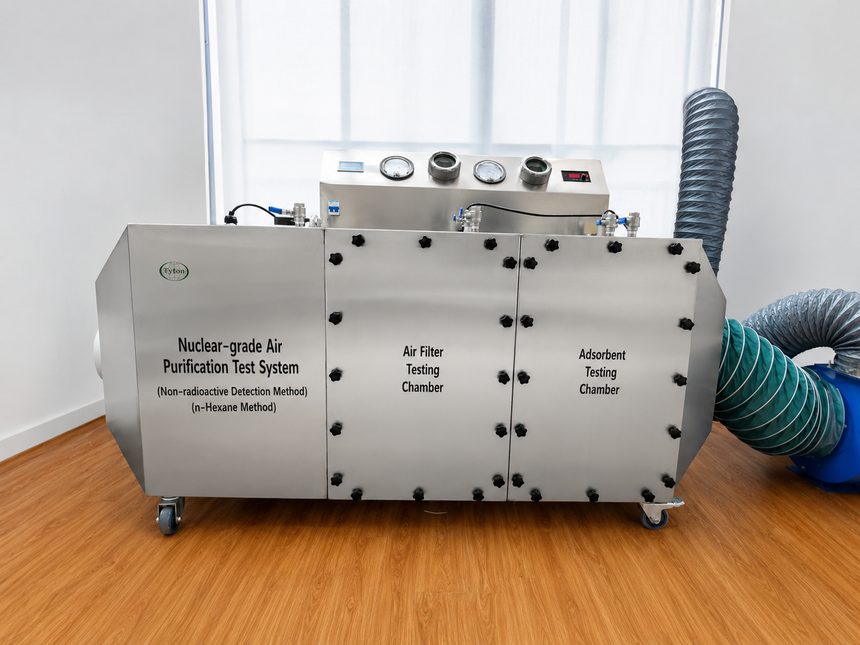
The DIN 3754 cyclohexane test method was developed in Germany as a practical, non-radioactive approach to routine surveillance testing of activated carbon adsorbers in nuclear ventilation systems. By using cyclohexane (C₆H₁₂) — a saturated alicyclic hydrocarbon — as a surrogate for radioiodine organics, the method avoids the need for radioactive material handling licenses and specialized containment facilities.
Test Conditions (DIN 3754)
| Parameter | Value / Specification |
|---|---|
| Test gas | Cyclohexane (C₆H₁₂) in air |
| Challenge concentration | ~1,000 ppm C₆H₁₂ (approx. 3,400 mg/m³) |
| Temperature | 20°C ± 2°C |
| Relative humidity | 50% ± 5% RH |
| Face velocity | 0.25 cm/s (typical surveillance velocity) |
| Result parameter | Dynamic Adsorption Capacity (DAC) in mg C₆H₁₂ per gram carbon |
| New carbon acceptance | DAC ≥ 100 mg/g |
| Used/in-service carbon acceptance | DAC ≥ 80 mg/g (typical) |
| Detection method | Flame ionization detector (FID) or gas chromatography (GC) |
| Primary standard | DIN 3754 (Germany); referenced in some ISO/EN standards |
Advantages of the Cyclohexane Method
- No radioactive material handling: No license required, no contamination risk, no waste generation.
- No toxic chemical handling: Cyclohexane is much less hazardous than methyl iodide (which is a carcinogen and alkylating agent).
- Fast and inexpensive: Test can be completed in 1–2 hours; equipment is simpler and cheaper than methyl iodide setups.
- Suitable for routine in-service surveillance: Can be performed in the field by nuclear facility maintenance staff without specialized radiological controls.
- Well-established in European practice: Decades of operational data with DIN 3754 cyclohexane testing exists for European nuclear facilities.
Limitations of the Cyclohexane Method
- Not representative of radioiodine chemistry: Cyclohexane is adsorbed primarily by physisorption (van der Waals forces); methyl iodide is captured by chemisorption (TEDA nucleophilic reaction). Different mechanisms, different kinetics.
- Larger molecule — different pore access: Cyclohexane (MW 84) is larger than methyl iodide (MW 142 ÷ — wait, CH₃I MW is 141.9). Actually cyclohexane (MW 84) is smaller, but pore accessibility and adsorption kinetics differ significantly.
- Not accepted by NRC: The US Nuclear Regulatory Commission does not accept cyclohexane as a surrogate for methyl iodide in nuclear power plant applications.
- Cannot detect TEDA content or reactivity: The cyclohexane test does not assess the TEDA impregnation level or its reactivity with methyl iodide — the most critical performance parameter.
- Humidity dependence differs from CH₃I: Carbon capacity for cyclohexane decreases with humidity differently than for methyl iodide, making cross-method comparisons inaccurate.
The Methyl Iodide Method (ANSI N509/N510, ASTM D3803)
Method Overview
The methyl iodide (CH₃I, iodomethane) test method is the gold standard for nuclear-grade activated carbon adsorber qualification. It uses methyl iodide as a chemical surrogate for organic radioiodine species (primarily CH₃131I) that are the primary radioactive iodine form in nuclear facility air streams. The test directly challenges the carbon's iodine capture chemistry — both physisorption and TEDA-mediated chemisorption — under conditions representative of actual nuclear facility operations.
While elemental iodine (I₂) is also present in nuclear facility air streams, organic iodides — particularly methyl iodide (CH₃131I) — are the most challenging form to capture on activated carbon. CH₃I is less reactive with TEDA than elemental I₂ and penetrates more easily through improperly impregnated or aged carbon. If carbon passes the CH₃I test, it will also adequately capture elemental I₂. The converse is not necessarily true — this is why CH₃I is used as the regulatory test challenge.
Test Conditions (ANSI N509/N510, ASTM D3803, NRC RG 1.52 Rev. 4)
| Parameter | Value / Specification |
|---|---|
| Test gas | Methyl iodide (CH₃I / CH₃131I) in air |
| Challenge concentration | 10 mg CH₃I per m³ air (≈ 1.7 ppm) |
| Temperature | 25°C – 30°C (NRC: 30°C ± 2°C per RG 1.52) |
| Relative humidity | 70% ± 5% RH (worst-case for TEDA performance) |
| Face velocity | 0.5 cm/s (maximum rated face velocity) |
| Bed depth | Per actual installed depth (min. 2 inches / 51 mm typical) |
| Exposure duration | 2 hours minimum (ASTM D3803) |
| Result parameter | CH₃I penetration (%) = downstream / upstream concentration × 100 |
| Alternatively | Decontamination Factor (DF) = 1 / penetration fraction |
| NRC acceptance criterion | ≤ 0.175% CH₃I penetration (DF ≥ 571) per NRC RG 1.52 Rev. 4 |
| Detection method | 131I gamma counting (if radioactive CH₃I) or GC (if non-radioactive CH₃I) |
| Primary standards | ANSI/ASME N509, ANSI N510, ASTM D3803, NRC RG 1.52 |
70% Relative Humidity — Why This Matters
The 70% RH test condition is deliberately conservative. Water vapor competes with CH₃I for TEDA active sites on the carbon surface, reducing effective capacity. Carbon that performs adequately at 70% RH is expected to perform even better at lower humidity conditions typical of actual nuclear facility air systems. Specifying 70% RH as the test condition provides a safety margin while remaining achievable for properly impregnated TEDA carbon.
Side-by-Side Comparison
| Parameter | Cyclohexane Method DIN 3754 |
Methyl Iodide Method ANSI N509/N510 · ASTM D3803 |
|---|---|---|
| Test gas | Cyclohexane C₆H₁₂ | Methyl iodide CH₃I |
| Radioactive? | No | Optional: ¹³¹I-labeled or non-radioactive |
| Challenge concentration | ~1,000 ppm (~3,400 mg/m³) | 10 mg/m³ (~1.7 ppm) |
| Test temperature | 20°C ± 2°C | 25–30°C (NRC: 30°C ± 2°C) |
| Relative humidity | 50% ± 5% | 70% ± 5% (worst-case) |
| Face velocity | 0.25 cm/s | 0.5 cm/s |
| Result expression | DAC (mg/g carbon) | CH₃I penetration (%) or DF |
| Pass criterion (new) | DAC ≥ 100 mg/g | ≤ 0.175% penetration |
| Pass criterion (used) | DAC ≥ 80 mg/g | ≤ 0.175% penetration |
| Detects TEDA reactivity? | ❌ No | ✅ Yes (directly) |
| Representative of ¹³¹I? | ❌ Only surrogate | ✅ Direct analog |
| NRC-accepted (US) | ❌ Not accepted | ✅ Required |
| European acceptance | ✅ Surveillance use | ✅ Initial qualification |
| Ease / cost | ✅ Simple, low cost | Specialized lab required |
| Hazardous material | None | CH₃I (carcinogen) — requires controls |
| Primary geographic use | Germany / Europe | USA (NRC) · International |
Why TEDA Impregnation is Required for Both Methods
Unimpregnated (virgin) activated carbon — regardless of its pore structure — has insufficient performance for nuclear-grade methyl iodide capture. The maximum CH₃I penetration through virgin carbon can be many orders of magnitude above the ≤0.175% NRC acceptance criterion. TEDA impregnation is essential.
The TEDA Mechanism
TEDA (triethylenediamine, also known as DABCO: 1,4-diazabicyclo[2.2.2]octane) reacts with methyl iodide via a nucleophilic substitution reaction (SN2):
TEDA (N(CH₂CH₂)₃N) + CH₃I → [TEDA-CH₃]⁺ I⁻
The nitrogen lone pair attacks the methyl carbon, displacing iodide and forming a stable quaternary ammonium salt. This is a chemisorption reaction — irreversible under normal conditions — explaining the high efficiency and stability of TEDA-impregnated carbon.
Key TEDA carbon specification parameters:
- TEDA content: Typically 2–5% by weight (exact value is proprietary to each manufacturer)
- BET surface area: ≥1,000 m²/g (coconut shell-based nuclear carbon)
- Hardness: ≥90% ball-pan hardness (resists attrition in service)
- Moisture content: ≤5% as-received
- Ash content: ≤5%
- Particle size: Typically 6×16 mesh (3.35×1.19 mm) for nuclear applications
NRC Regulatory Requirements
NRC Regulatory Guide 1.52 (Rev. 4, 2012) establishes the design, testing, and maintenance criteria for Nuclear Power Plant Air Cleaning Systems. For activated carbon adsorbers, the key provisions are:
| Requirement | NRC Specification (RG 1.52 Rev. 4) |
|---|---|
| Test method | ASTM D3803 / ANSI N510 methyl iodide |
| CH₃I concentration | 10 mg/m³ |
| Temperature | 30°C ± 2°C |
| Relative humidity | 70% ± 5% RH |
| Face velocity | ≤ 0.5 cm/s |
| Acceptance criterion | ≤ 0.175% CH₃I penetration (DF ≥ 571) |
| Initial carbon qualification | Tested per ASTM D3803 before installation |
| In-service surveillance | Representative carbon samples per ANSI N510 at defined intervals |
| Cyclohexane test (DIN 3754) | Not accepted as substitute for nuclear power plants |
37 US states have Agreement State status, operating their own nuclear regulatory programs. While NRC's RG 1.52 applies to nuclear power plants, Agreement State programs govern medical, research, and industrial nuclear users. Some Agreement State programs may have different requirements — always verify with your state radiation control program. In general, for all applications where radioiodine capture efficiency matters to public health, methyl iodide testing provides the only direct measurement of actual performance.
When to Use Cyclohexane vs Methyl Iodide
Use Methyl Iodide (CH₃I) Testing When:
- NRC-licensed nuclear power plant or fuel cycle facility (required)
- Initial qualification of a new carbon lot for nuclear use
- Regulatory compliance documentation is required
- High-dose hospital I-131 therapy room exhaust filtration
- Radiochemical laboratory or hot cell ventilation
- Any application where a specific iodine removal efficiency must be guaranteed
Use Cyclohexane (DIN 3754) Testing When:
- European nuclear facility routine in-service surveillance (supplementary to initial CH₃I qualification)
- Rapid field assessment of carbon condition without radioactive material handling
- Industrial (non-nuclear) activated carbon capacity screening
- Research comparison of carbon lots where relative capacity is sufficient
- Pre-qualification screening (to identify obviously depleted carbon before investing in CH₃I testing)
Do not substitute cyclohexane testing for methyl iodide testing in any application where regulatory compliance with NRC, ANSI N509/N510, or ASTM D3803 is required. A carbon bed that passes DIN 3754 cyclohexane testing may not meet ANSI N510 methyl iodide requirements — especially if the TEDA impregnant has degraded, leached, or if the carbon has been exposed to acid gases, solvent vapors, or excessive humidity that selectively degrades TEDA without significantly affecting cyclohexane capacity.
IAS Carbon Adsorber Products and Testing Standards
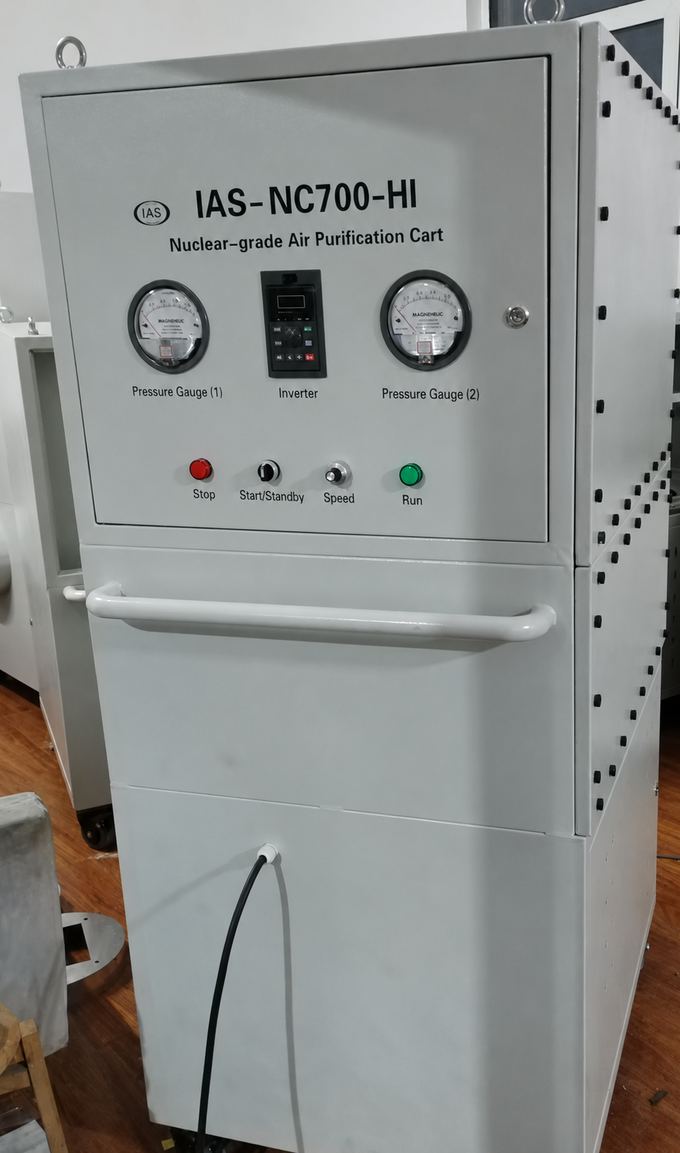
Iodine Air Systems portable nuclear air purification carts (IAS-NC700-HI, IAS-NC500-HI-CUSTOM) use nuclear-grade TEDA-impregnated activated carbon that is factory-qualified by methyl iodide testing per ANSI N509/N510 before shipment. Each carbon filter element ships with:
- Factory CH₃I penetration test certificate
- TEDA content verification
- Physical properties data (BET surface area, hardness, particle size, moisture, ash)
- Batch traceability documentation
Nuclear-Grade Carbon Adsorber Systems
IAS-NC700-HI (700 CFM · $22,800/unit FOB qty 8) and IAS-NC500-HI-CUSTOM (500 CFM · 16-in. carbon bed · fold-down plenums). TEDA carbon qualified per ANSI N509/N510. HEPA ≥99.97%. CIF worldwide available.
Engineering FAQ
▶ Can cyclohexane DAC be converted to methyl iodide penetration?
There is no reliable direct conversion factor between cyclohexane DAC and methyl iodide CH₃I penetration. The two test methods probe fundamentally different adsorption mechanisms (physisorption for cyclohexane, chemisorption for CH₃I via TEDA), different test conditions (20°C/50% RH vs 30°C/70% RH), and different molecular species. While statistical correlations exist in research literature for specific carbon types, they cannot be applied universally or substituted for direct methyl iodide measurement in regulatory contexts.
▶ Does NRC accept non-radioactive CH₃I for the methyl iodide test?
Yes. The methyl iodide test per ASTM D3803 / ANSI N510 can be performed with non-radioactive CH₃I detected by gas chromatography (GC), or with radioactive 131I-labeled CH₃I detected by gamma counting. NRC RG 1.52 does not require radioactive CH₃I — what matters is that the test uses methyl iodide at the specified concentration (10 mg/m³), temperature (30°C ± 2°C), relative humidity (70% ± 5%), and face velocity (≤0.5 cm/s), regardless of whether the iodine is radioactive or stable. Using non-radioactive CH₃I avoids radioactive material handling requirements while producing an equivalent test result.
▶ How often must nuclear carbon adsorbers be tested in service?
For NRC-licensed nuclear power plants, ANSI N510 and RG 1.52 require representative carbon sample testing at defined intervals — typically annually, or after any event that may have challenged the carbon (flooding, fire, chemical release, prolonged operation at elevated humidity). Samples are taken from multiple locations in the carbon bed, tested individually, and the results used to evaluate the entire bed's continued qualification. In addition, in-place HEPA and carbon adsorber system leak testing is required following any significant maintenance action that could have disturbed filter media or housing integrity.
▶ Can acid gas exposure cause a carbon to fail methyl iodide while passing cyclohexane?
Yes — this is one of the most critical failure modes that the cyclohexane test cannot detect. Hydrogen chloride (HCl), sulfur dioxide (SO₂), and other acid gases react preferentially with TEDA, destroying its nucleophilic reactivity and reducing CH₃I capture efficiency. However, because acid gas exposure affects the TEDA impregnant without significantly changing the carbon's physisorption capacity for organics, a carbon damaged by acid gas exposure may retain adequate cyclohexane DAC while having completely failed its methyl iodide acceptance criterion. This is why annual methyl iodide testing of in-service nuclear carbon is critical and cannot be replaced by cyclohexane surveillance alone.