Home › Blog › Nuclear Air Purification Carts in Production
Production Notes · November 2026
Inside the build: IAS-NC1800-HI and IAS-NC900-HI nuclear air purification carts in assembly
Two sizes of our IAS-NC nuclear air purification cart on the assembly floor at the same time: the 1,800 CFM class IAS-NC1800-HI with touchscreen control and a sensor package, and the 900 CFM class IAS-NC900-HI in its simpler keypad configuration — photographed during assembly and bench testing, inside and out.
November 20, 2026Iodine Air Systems4 min read
Quick answer
The photographs in this production note show two mobile nuclear air purification carts in assembly: the IAS-NC1800-HI, rated 3,000 m³/h (about 1,800 CFM class), with a touchscreen HMI, digital and analog differential-pressure gauges and a fitted sensor package (GPS module, RS485 temperature-and-humidity transmitter); and the IAS-NC900-HI, rated 1,500 m³/h (about 900 CFM class), with variable-frequency-drive keypad control. Both are caster-mounted 304 stainless-steel carts with a panel prefilter over a HEPA box and an impregnated-carbon iodine adsorber stage in the HI configuration. Airflow class, filter configuration, voltage and plug standard are confirmed per order before production.
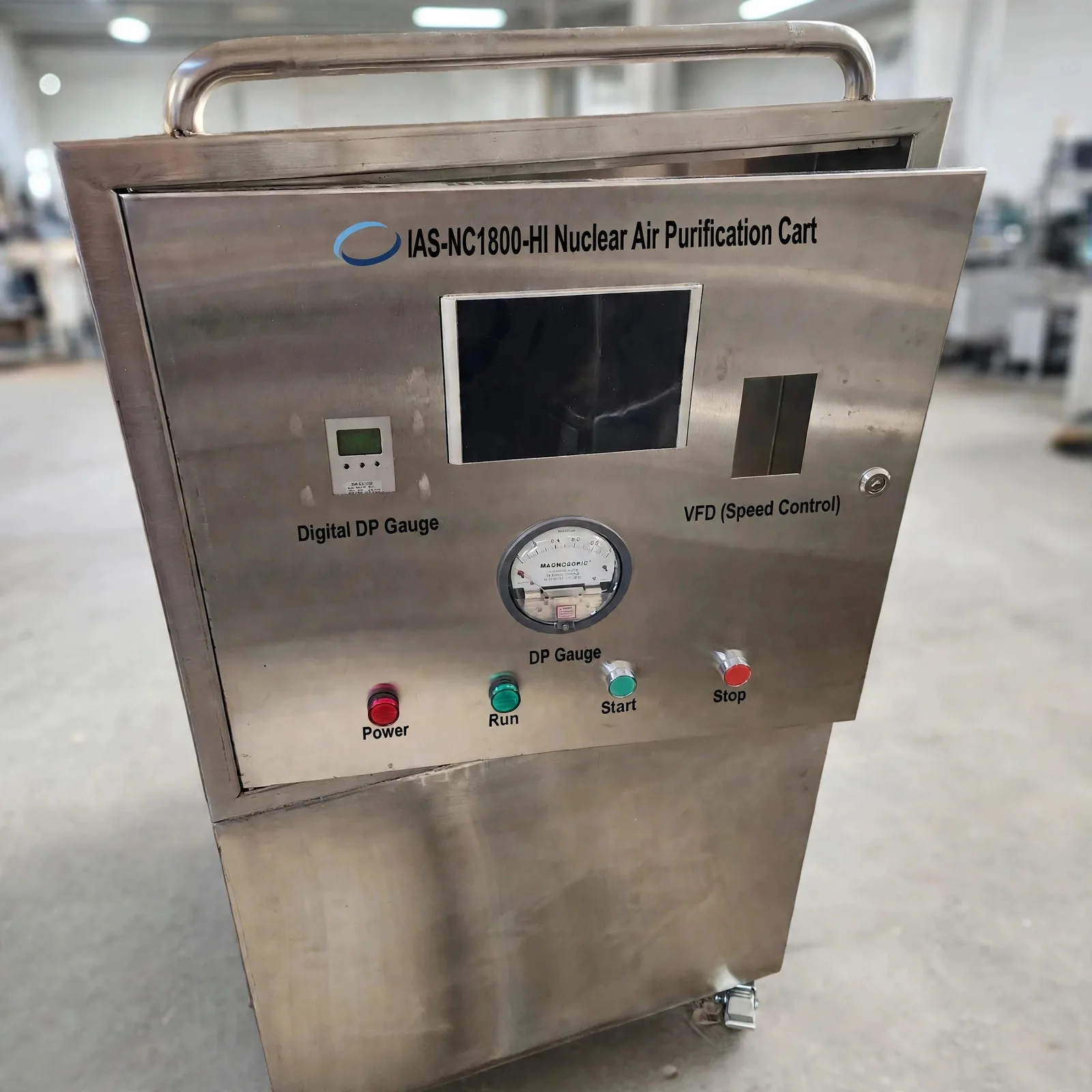
The IAS-NC1800-HI front panel in its English export configuration: touchscreen HMI (top left), digital differential-pressure meter and analog gauge, variable-frequency drive section, and power / run / start / stop push buttons.
Two sizes of the same cart line
The IAS-NC line scales one architecture across work zones. The IAS-NC900-HI covers a single work zone or small containment at 1,500 m³/h; the IAS-NC1800-HI doubles that to 3,000 m³/h for larger zones and outage work fronts. Both share the same layout — cross-perforated intake at the base, filtration train above it, fan and controls in a stainless housing on locking casters — so crews trained on one size already know the other.
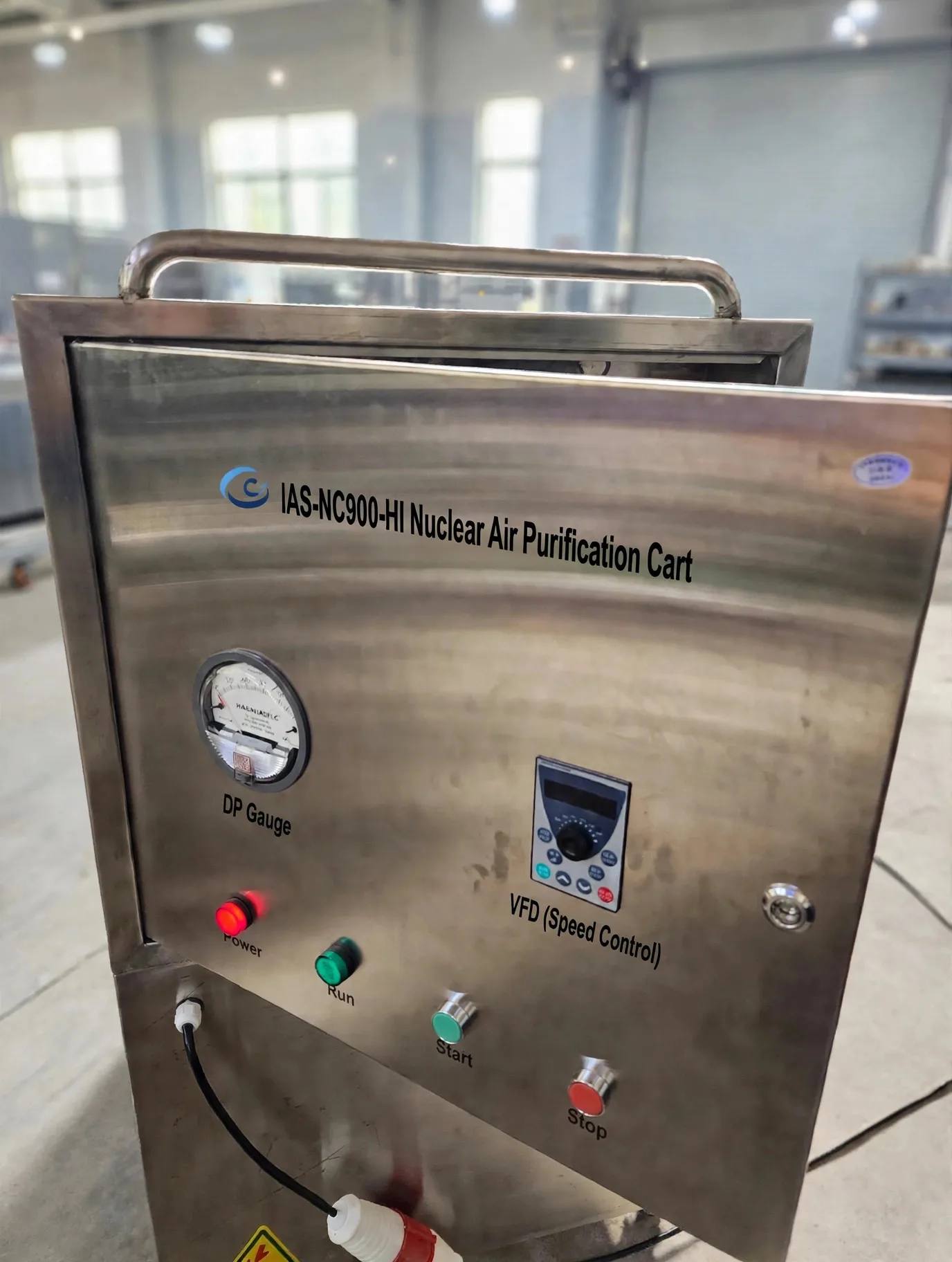
The pair photographed here also shows the line's two control philosophies. The NC900-HI below is the straightforward configuration: a variable-frequency drive keypad and an analog differential-pressure gauge. The NC1800-HI above is the instrumented configuration, built around a touchscreen HMI. A recent customer-specified NC900-HI Custom order, with remote start and radiation monitoring, is covered in its own production note.
The IAS-NC900-HI front panel, powered up on the bench: VFD keypad for fan speed, analog differential-pressure gauge, and large physical push buttons that work with gloved hands.
The filtration train, before the covers go on
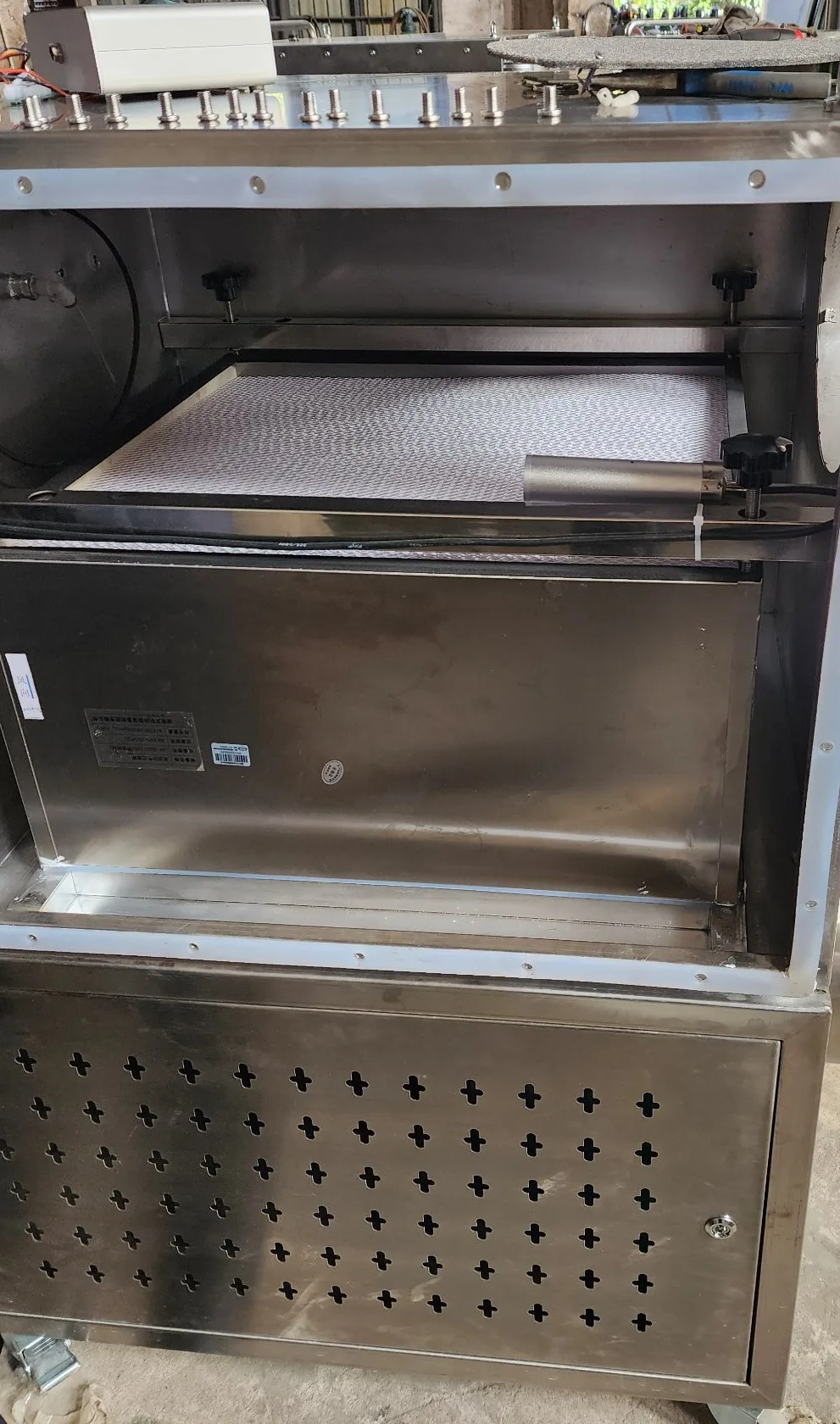
Assembly photographs show what a finished product page cannot: the order air actually travels. Room air enters through the cross-perforated panel at the base of the cart, passes a panel prefilter that takes out coarse dust, and then the main HEPA box below it; in the HI configuration an impregnated-carbon adsorber stage handles radioiodine. The prefilter is the cheap, sacrificial layer — it keeps the HEPA and carbon stages from loading early, and it swaps out in minutes on the star knobs visible in the frame, without tools.
Inside the IAS-NC1800-HI: panel prefilter (top) over the HEPA box, with the cross-perforated intake panel below. Filter stages are clamped, not glued — change-out is a bench job, not a rebuild.
The same primary-filter format appears across the line, which keeps site spares simple: one prefilter size to stock, one change-out routine to train. Filter configuration is confirmed per order — see the carbon and filter replacement guide for how change-outs are scheduled in service.
Controls: touchscreen on the big cart, keypad on the small one
Both carts drive the fan with a variable-frequency drive, so airflow is set to the job instead of being fixed at full speed. The difference is the interface. On the IAS-NC1800-HI, a touchscreen HMI fronts the drive, backed by two independent differential-pressure readouts — a digital transmitter and a mechanical analog gauge — so filter loading can be read even with the electronics off. On the IAS-NC900-HI, the drive's own keypad does the same job with fewer parts.
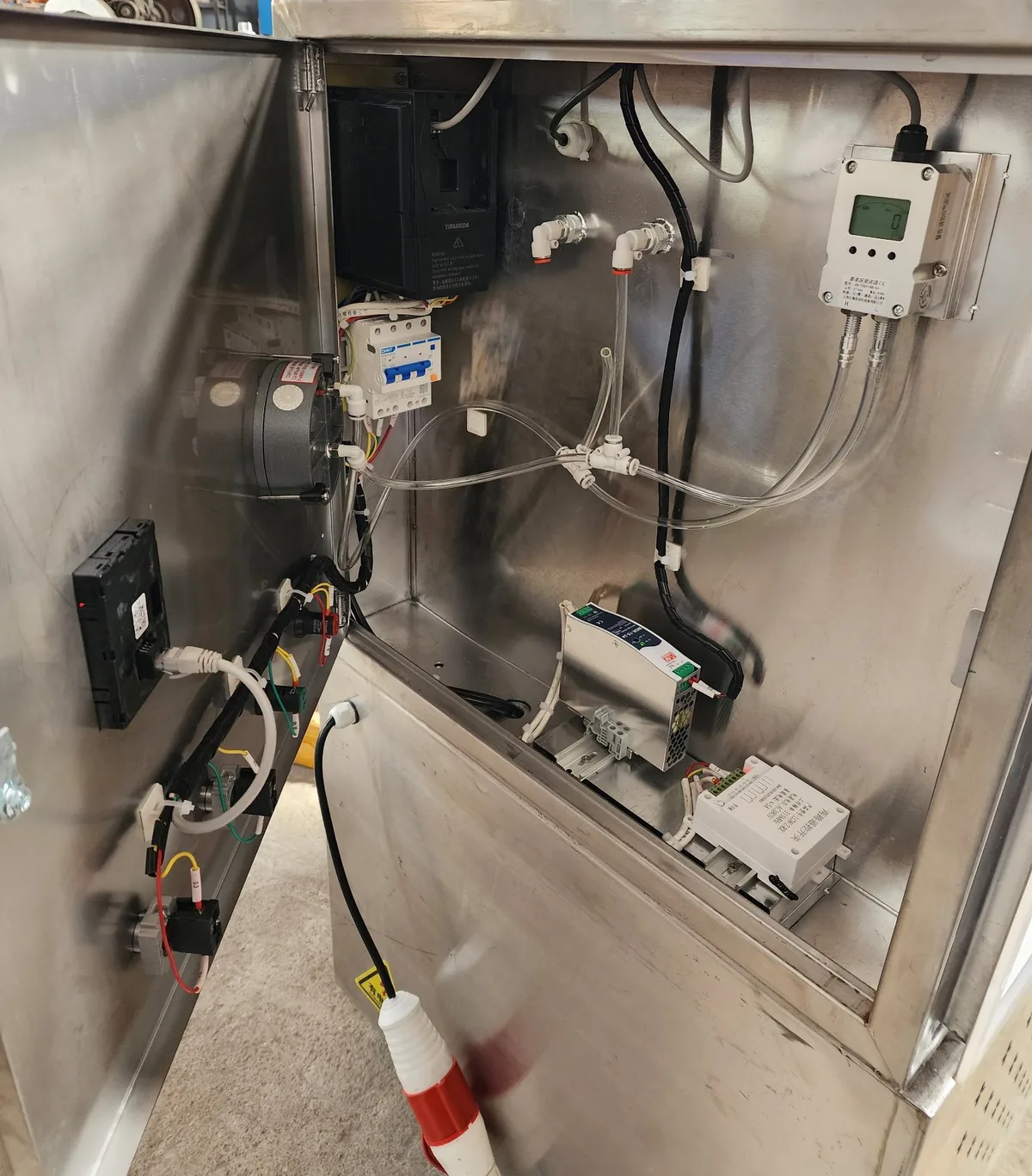
Inside the IAS-NC1800-HI control cabinet: variable-frequency drive (top left), circuit breaker, digital differential-pressure transmitter with its sample lines (right), power supply and the remote-control module on the cabinet floor.
The cabinet is laid out for service, not just for the photograph: standard DIN-rail components, labelled sample tubing for the pressure transmitter, and a heavy-duty industrial plug. If a drive or breaker ever needs swapping in the field, it is a like-for-like component change.
The sensor package on the instrumented cart
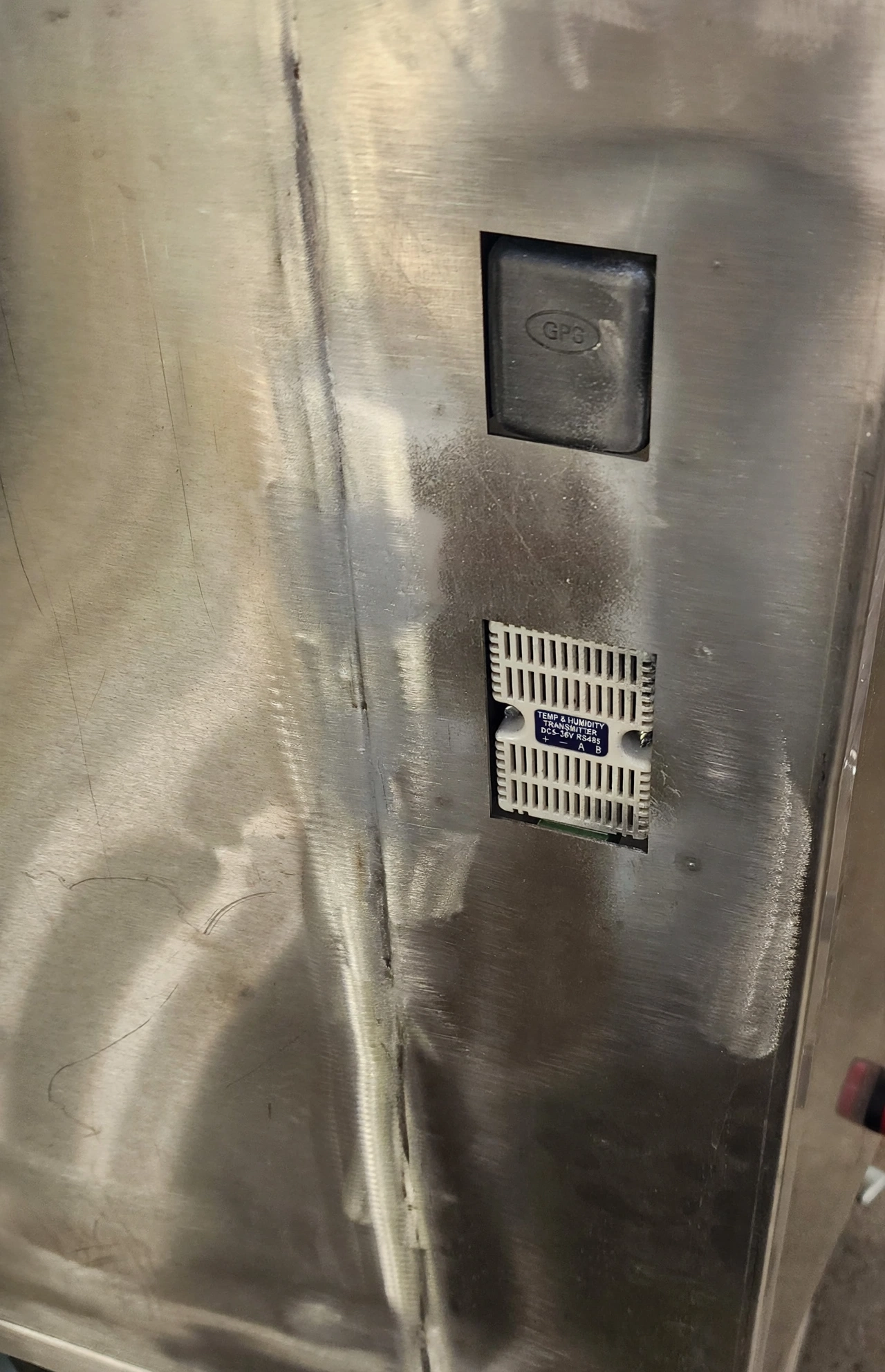
On the side panel of the IAS-NC1800-HI, two small modules mark this out as the instrumented configuration: a GPS module and a temperature-and-humidity transmitter with an RS485 output. Together with the digital differential-pressure transmitter in the cabinet, they give the cart a monitoring package that reports into the site's systems instead of standing alone — filter condition and ambient conditions are data, not guesswork.
Fitted to the IAS-NC1800-HI side panel: GPS module (top) and the temperature-and-humidity transmitter (DC 5–36 V, RS485) below it.
Monitoring is configured per order. The NC900-HI Custom order described in our earlier production note carried gamma probes before and after the filter stage with dose-rate alarms and logging; the package on any given cart is set by the site specification it is built against.
Built to order, bench-tested before dispatch
These photographs were taken during assembly and bench testing — panels powered, drives running, gauges live — which is the last point at which a configuration can be checked end to end before a cart is crated. Carts are built to order: airflow class, filter configuration, monitoring package, voltage and plug standard are all confirmed against the site specification before production starts.
Sizing a cart for your own work zone starts with room volume and target air changes — the air cart sizing guide works through the arithmetic and the free sizing calculator applies it to our cart classes. For a configuration and quotation, contact sales@iodineairsystems.com.
Questions
What is the difference between the IAS-NC1800-HI and the IAS-NC900-HI?
Airflow class and instrumentation. The IAS-NC1800-HI is rated 3,000 m³/h (about 1,800 CFM class) and carries the instrumented package: touchscreen HMI, digital and analog differential-pressure gauges, GPS module and an RS485 temperature-and-humidity transmitter. The IAS-NC900-HI is rated 1,500 m³/h (about 900 CFM class) with VFD keypad control and an analog gauge. Both share the same stainless cart architecture and filtration concept.
What filters are inside these carts?
A panel prefilter over a HEPA box, with an impregnated-carbon iodine adsorber stage in the HI configuration. The prefilter is sacrificial and tool-free to change; it protects the HEPA and carbon stages from early loading. The exact filter set is confirmed per order.
What does the differential-pressure gauge do?
It reads the pressure drop across the filter stages. As filters load, the reading rises, so the crew can see a change-out coming instead of guessing from a calendar. The instrumented cart reads it twice — a digital transmitter and an analog gauge — so the value is available even with the electronics off.
Can a cart be configured for our site?
Yes. Carts are built to order: airflow class, filter configuration, monitoring package, voltage and plug standard are confirmed against the site specification before production. Email sales@iodineairsystems.com with the work-zone size and the task, and we will propose a configuration.
Production note published November 20, 2026. Photographs show IAS-NC1800-HI and IAS-NC900-HI units during assembly and bench testing, with front panels in their English export configuration; delivery sites are not disclosed. Specifications are confirmed per order against the site specification. Iodine Air Systems products are designed to EJ/T 20088-2014 and are not currently ASME AG-1 or NQA-1 certified (qualification via partners on request). For configurations and quotations, contact sales@iodineairsystems.com.