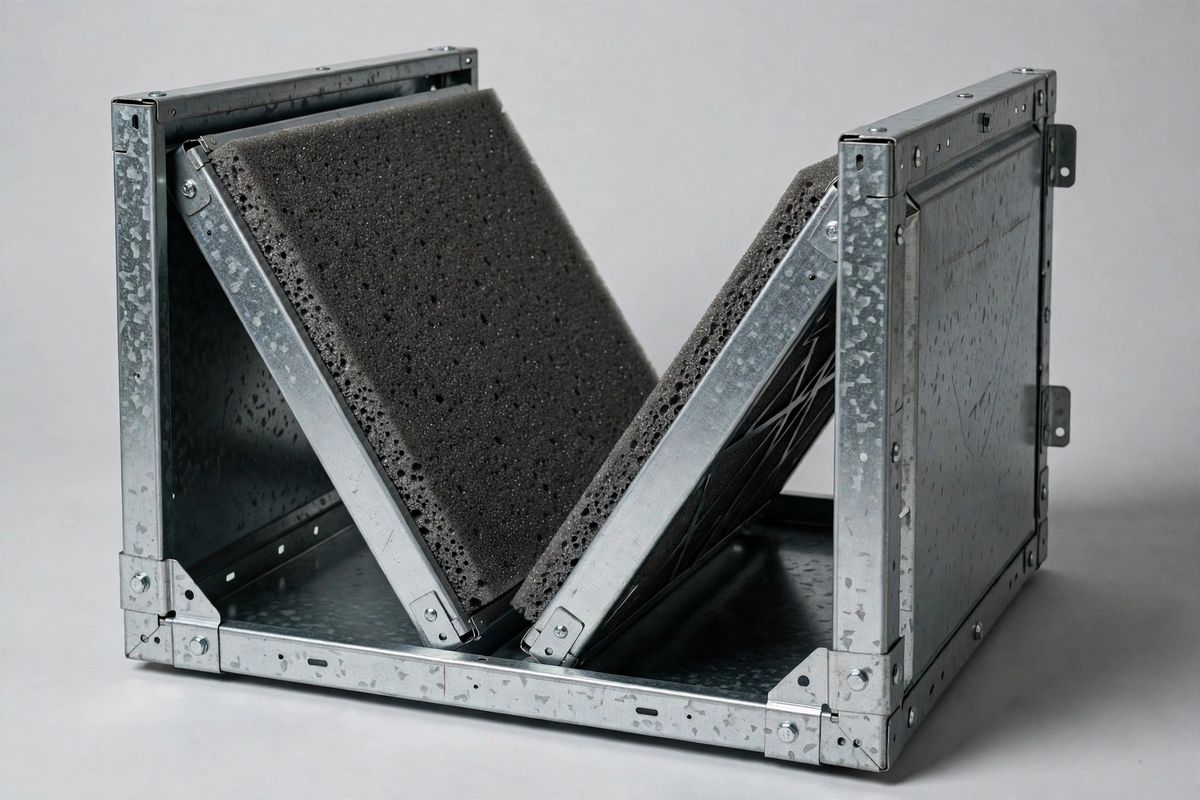
IAS-PF-VB2424 In-Duct V-Bank Module
The Zero-Ozone Alternative
Technical Data Sheet — Revision 1.0 · Effective Date: November 2026 · Passive filtration: no fan, no power, no ozone · Specifications to US practice (CFM, inches, in. w.g.)
module
physics, not filters
UV-C in a Duct Filters Nothing
In-duct UV-C and ionisation are sold as air treatment, but they remove no dust at all — the particles sail straight through — while the lamps become a replacement annuity and the ozone question follows every installation (zero-ozone claims need UL 2998 validation for a reason). The IAS-PF-VB2424 does the unglamorous thing instead: it physically filters the air. A V-bank of nickel-iron foam cassettes gives a deep, low-pressure-drop bed in a standard 24×24×12 envelope — no power, no lamps, no ionisation, and zero ozone not as a rating but as a physical fact: there is nothing in the module that could make any.
Physical Filtration. Nothing Else.
The IAS-PF-VB2424 has no fan, no motor, no ioniser and no UV lamp. It filters the way a sieve catches gravel — mechanically, through a three-dimensional metal foam depth bed — using only the airflow the building already moves. That is why it produces zero ozone (there is no electrical process that could), draws zero power of its own, and holds no part that wears out on a schedule. When it loads, you wash it — about five minutes — and it returns to its clean pressure drop. Media design life is 10+ years; there are no replacement elements to buy, stock or landfill. The media is solid metal: inherently non-combustible and flame-retardant — a porous metal structure quenches flame rather than feeding it, which is the same property that makes metal foam a flame-arresting material, and a decisive advantage over paper or polymer media in any fire-conscious facility.
Complete Technical Specification
| Model | IAS-PF-VB2424 |
| List price | USD 1,490 per module — volume and OEM / private-label pricing on request |
| Nominal size | 24 × 24 × 12 in [610 × 610 × 305 mm] envelope — standard V-bank / AHU slot |
| Media | Open-cell nickel-iron foam cassettes, 10 PPI + 30 PPI, arranged as two V-pairs |
| Frame | Galvanised steel (304 stainless steel option) |
| Rated airflow | 2,500 CFM |
| Clean pressure drop | ≤ 0.35 in. w.g. (87 Pa) at rated airflow |
| Electrical | None — no lamps, no ballasts, no ionisation, no controls |
| Weight | 41 lb (18.6 kg) |
| Filtration type | Passive — physical (mechanical) depth filtration only; no ionisation, no UV, no electrical air treatment |
| Ozone | Zero — no ozone-generating process is present |
| Power consumption | None — uses existing building / machine airflow |
| Consumables | None — the metal foam media is simply washed and reused; there are no replacement elements to buy |
| Maintenance | Wash with water (mild detergent if needed), drain and dry; about 5 minutes per cassette |
| Media design life | 10+ years |
Applications
- Commercial AHU and duct banks in offices, hotels, schools and hospitals
- Retrofits replacing disposable V-bank / bag filter slots
- Facilities that have ruled out UV-C / ionisation over ozone and by-product concerns
Questions about IAS-PF-VB2424
How does it compare with a disposable V-bank filter?
Same slot, same duty — but the foam cassettes wash and reuse for 10+ years instead of being replaced on a schedule, and pressure drop recovers fully with each wash.
Is "zero ozone" a certification claim?
It is a construction fact: the module contains no electrical or photochemical process at all. There is no lamp, ioniser or plasma stage that could generate ozone.
Can it stage ahead of existing final filters?
Yes — it is commonly the permanent first stage ahead of existing final filters or gas-phase stages, extending their service life.