Metal Foam Active Air
Filtration Systems
Fan-powered filtration units built around permanent, washable open-cell metal foam media — engineered for high-dust desert air and high-humidity coastal air.
at 1–3 µm
at 3–10 µm
porosity
wash & reuse
at rated airflow
A Filter You Wash,
Not Replace
Metal foam is a porous metal with a sponge-like, open-cell structure: a three-dimensional network of thin metal struts with a very large internal surface area at low weight and low pressure drop. Dust is captured through the depth of the foam, not just on its face — and when the pressure drop rises, the media comes out, is rinsed or pressure-washed in about five minutes, and goes back in with its performance restored. There is no paper or glass-fibre element to buy, stock, or landfill.
The IAS-AF series packages this media into active, fan-powered filtration units: a two-stage metal foam train in front of a variable-speed EC fan, in two regional configurations. The Desert Specification (DS) uses a coarse nickel-iron foam first stage that takes the sand and dust load of desert air, ahead of a finer main stage. The Humidity Specification (HS) uses corrosion-resistant nickel foam in a 304 stainless housing with a condensate drain, for air that is hot, wet, and salty.
Media performance figures are the published values for this metal foam family (see PrometheanFoam material data): 92.4% fractional efficiency at 1–3 µm and 96.8% at 3–10 µm, 85–95% porosity, and a two-stage clean pressure drop of 120–180 Pa in industrial service.
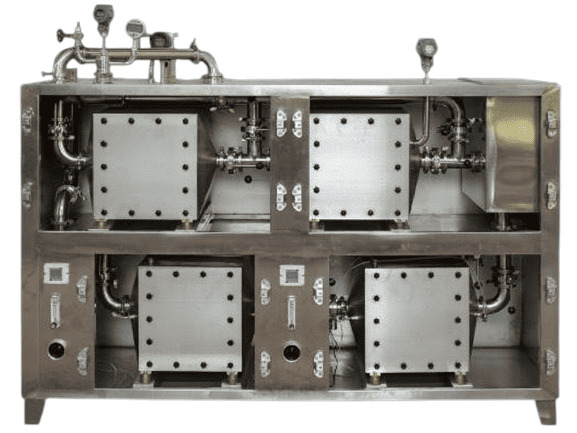
IAS-AF Series Active Filtration Units
IAS-PF Series Passive Filter Cassettes & Panels
The PF series takes the same permanent metal foam media and removes the machine around it. A PF cassette has no fan, no motor, no power supply and no electronics at all — it is pure physical filtration that rides the airflow your building or machine already moves. That makes it the zero-ozone option by construction (there is no electrical process that could produce ozone), the zero-energy option, and the zero-consumables option: wash it, and it is new again. The same porous metal is the flame-arresting, explosion-protection material proven across oil and gas operations — it quenches flame instead of feeding it. Five formats cover the five places disposable filters burn the most money:
Refillable Gas-Phase & Standard Cartridges
Two more places where the US installed base buys the same consumable forever — answered the same way: permanent hardware, commodity media, honest aftermarket pricing. The GP series replaces sealed gas-phase modules with a refillable V-bank housing plus bulk media by the bag; the CART line supplies the standard dust-collector cartridge with fit confirmed in writing, no brand lock-in.
Arizona: Built for Dust Storms
Desert air is a consumables problem. Haboob dust storms in the Phoenix–Tucson corridor drive PM10 spikes into the 1,000–5,000 µg/m³ range, and a paper prefilter that was sized for ordinary city air can blind in a single event — after which the choice is a service call or a choked air handler. Metal foam changes the maintenance model: the coarse 10 PPI nickel-iron first stage of the DS configuration loads through its depth instead of caking on a face, the differential-pressure gauge says when to wash, and a five-minute rinse restores the media instead of replacing it.
- Data center and warehouse intake and make-up air across the US Southwest (Phoenix, Tucson, Las Vegas)
- Evaporative-cooler and rooftop-unit intake protection
- Manufacturing and logistics halls with wind-blown dust ingress
- Field data on this media family in Arizona service: cleaning intervals measured in weeks — up to 14 weeks in data center duty — not days
Florida: Built for Wet Air
In Florida and the Gulf Coast the enemy is water. Paper and glass-fibre media absorb humidity, sag, lose efficiency, and give mould a surface to grow on; change-outs come faster and cost more. The HS configuration removes the organic media entirely: nickel foam does not absorb water, drains freely, and is corrosion-resistant — including in coastal salt air — and the 304 stainless housing is fitted with a condensate drain for continuous duty at up to 95% relative humidity.
- Hotels, resorts and coastal commercial buildings
- Food and beverage plants and commercial kitchens' make-up air
- Gyms, schools and healthcare-adjacent commercial spaces (non-sterile areas)
- Coastal warehouses and light industrial halls
The Operating-Cost Case
| Factor | Disposable media | IAS-AF metal foam |
|---|---|---|
| Media life | 3–6 months, then replace | 10+ years, wash & reuse |
| Efficiency over time | Degrades silently | Restored at every wash |
| Cleaning / change-out | Discard and fit new media | ≈5 minutes per stage, rinse or pressure wash |
| Dust-storm event | Media can blind in one storm | Wash and return to service |
| High humidity | Absorbs water, sags, supports mould | Metal media drains; nothing organic to degrade |
| Waste | 100% to landfill | No disposable media; foam is recyclable metal |
| Fire behaviour | Media is a fuel load — worse when oil- or dust-laden | Solid metal: non-combustible and flame-retardant; the porous structure quenches flame |
Specified for the US Market
The IAS-AF series is specified the way US buyers and inspectors work: airflow in CFM, dimensions in inches, pressure drop in in. w.g., temperatures in °F, 120 V / 60 Hz electrical (NEMA 5-15P cord on the AF900), and media cassettes in the US-standard 24 × 24 in filter envelope, so the units interface with standard American ductwork, filter banks and building power. Filtration is purely mechanical — no ionization, no plasma, no UV — so the units generate zero ozone and stay clear of the ozone limits that restrict electronic air cleaners in California and other states. The media itself is solid metal: nothing to burn, nothing to absorb water, nothing to throw away.
Questions about Metal Foam Filtration
Is metal foam a HEPA replacement?
No. The IAS-AF series is a high-capacity particulate filtration stage for dust, PM10 and PM2.5-class loads — the duty that destroys disposable prefilters. Where a code or process requires HEPA or gas-phase removal, the AF unit stages ahead of that equipment and extends its life; see our data center final filters and nuclear filtration lines.
How do I know when to wash the media?
Each unit has differential-pressure gauge ports across the media train. When the reading approaches roughly twice the clean pressure drop, wash the stages — about five minutes each — and the pressure drop returns to its clean value.
Can the units be supplied under our brand, or in a custom configuration?
Yes. OEM and private-label supply — your branding, electrical configuration, housing material and colour — is handled under our OEM custom manufacturing program; custom builds carry the CUSTOM suffix in the model number.
What does "active" mean here?
The AF series is fan-powered: a variable-speed EC fan inside the unit moves the rated airflow through the media train, so the units work as stand-alone recirculation cleaners or as powered intake/make-up air units, independent of a central air handler.