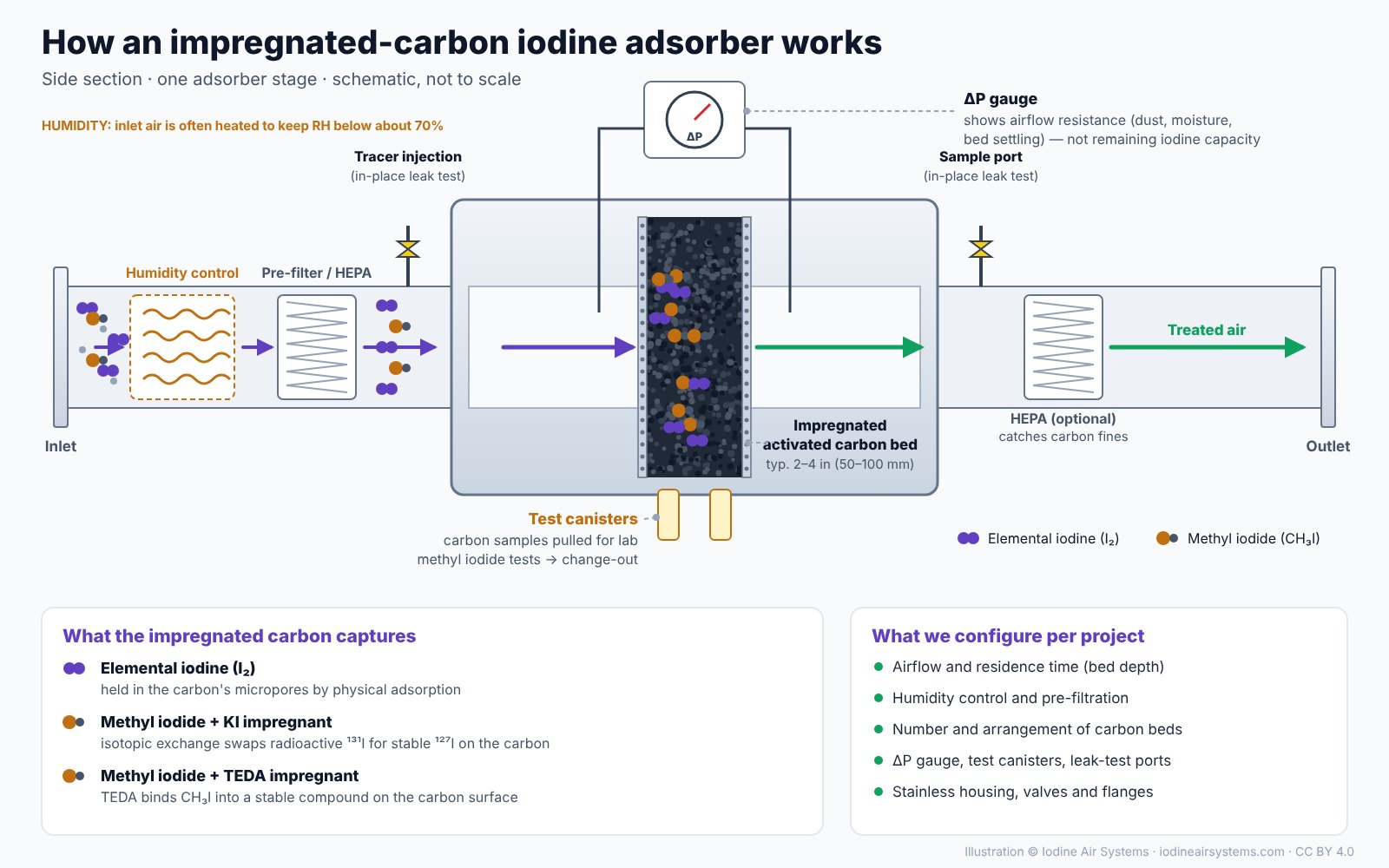
How an Iodine Adsorber Removes Radioactive Iodine
Radioactive iodine leaves a process in two main forms. Elemental iodine (I₂) sticks readily to activated carbon. Organic iodides, above all methyl iodide (CH₃I), slip through plain carbon, which is why nuclear adsorbers use impregnated carbon and why methyl iodide is the species every nuclear-grade carbon is tested against.
I₂ molecules are held in the carbon's micropores. Plain activated carbon already does this well.
Potassium iodide on the carbon lets radioactive iodine-131 in CH₃I swap places with stable iodine-127, so the radioactive atom stays on the carbon.
Triethylenediamine (TEDA) reacts with CH₃I to form a stable compound on the carbon surface. Many nuclear carbons combine TEDA and KI.
The Delivered System
The JJH-100 adsorber in the foreground carries the differential-pressure gauge and valved sample / isolation points; the two JJH-50 impregnated activated-carbon adsorber beds behind it complete the delivered set.
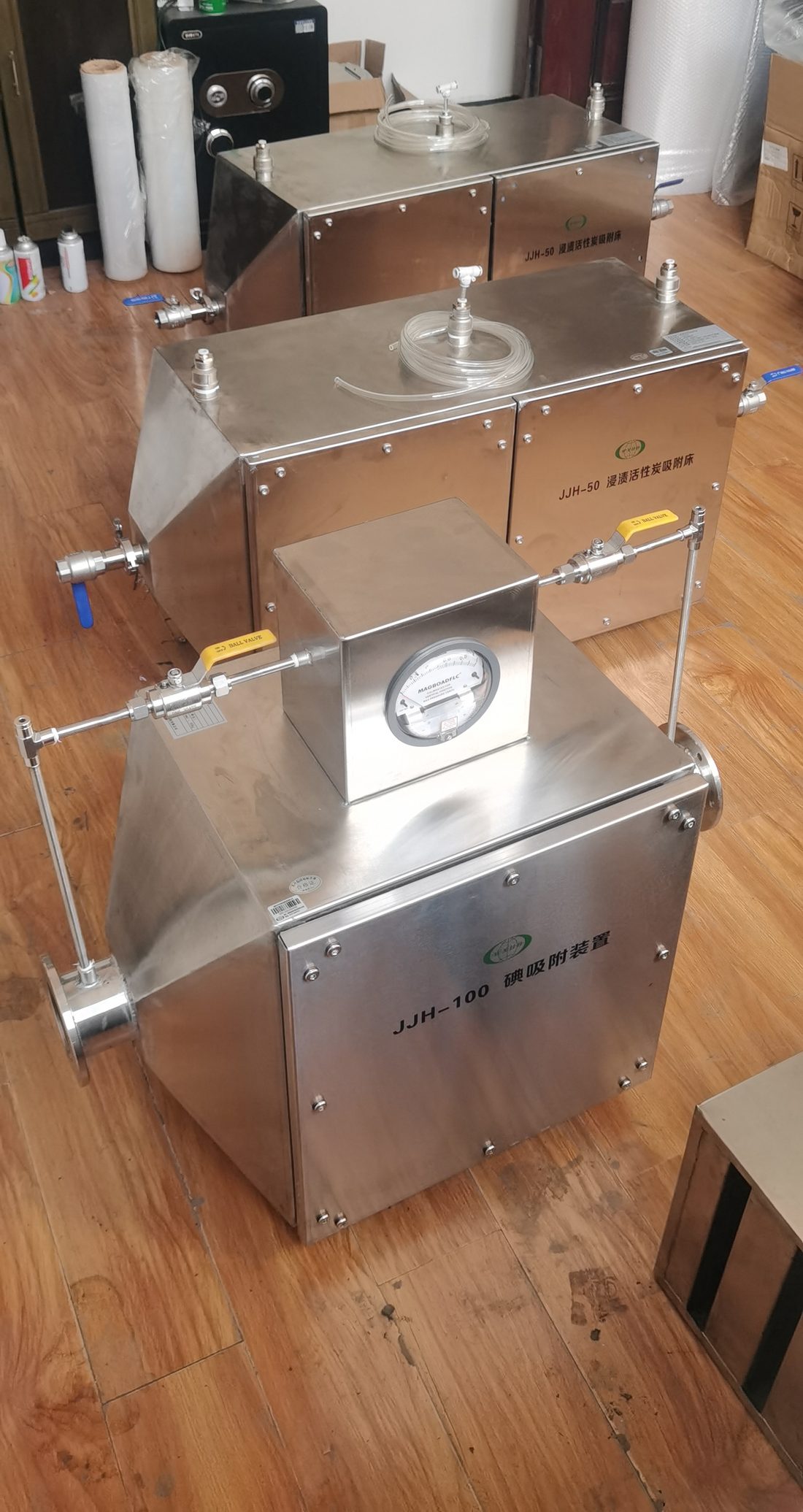
What the Delivered Configuration Includes
| Item | As Delivered / Basis |
|---|---|
| Adsorber Unit | JJH-100 iodine adsorber (model mark as photographed) |
| Construction | Stainless-steel vessel and bed housings |
| Carbon Beds | 2 × JJH-50 impregnated activated-carbon adsorber beds (model mark as photographed) |
| Carbon | Nuclear-grade impregnated activated carbon (standard multi-component impregnant; TEDA, KI or TEDA + KI on request) |
| Monitoring | Differential-pressure gauge across the adsorber (airflow resistance and running check) |
| Connections | Ball-valve isolation and sample points; flanged duct connections |
| Vessel Size, Airflow, Beds | Configured to project requirements |
The Parameters That Decide Adsorber Performance
These are widely used design references in nuclear air treatment. Your site's licensing basis or technical specifications always take precedence, and we configure each unit to them.
| Parameter | Common design reference | How we configure it |
|---|---|---|
| Carbon bed depth | 2 in (50 mm) per bed is common; deeper or multiple beds where higher efficiency is credited | Bed count, depth and arrangement set to your efficiency target |
| Residence time | About 0.25 s per 2 in of bed is a widely used basis in US practice (NRC Regulatory Guide 1.52) | Vessel face area sized to your airflow so residence time is met |
| Inlet humidity | Inlet air is often heated to keep relative humidity below about 70%; water vapour competes with methyl iodide for the carbon | Heater or humidity control upstream where the air stream is humid |
| Particulates | Pre-filter / HEPA upstream keeps dust and aerosols off the carbon | Upstream filtration and optional downstream HEPA for carbon fines |
| Carbon efficiency test | Laboratory methyl iodide test of carbon samples; ASTM D3803 is the method most US nuclear sites specify | Test canisters in the bed; in-house rig testing, or third-party ASTM D3803 at cost |
| Housing leak test | In-place tracer-gas bypass test (ASME N510 / ASME AG-1 Section TA) | Upstream injection and downstream sample ports built in |
| Bed condition | ΔP shows airflow resistance (dust, moisture, settling), not remaining iodine capacity | ΔP gauge fitted; change-out planned from test-canister results |
Design Points
Stainless Construction Throughout
Adsorber vessel and bed housings in stainless steel for corrosion resistance and decontamination-friendly surfaces.
Nuclear-Grade Impregnated Carbon
Our own impregnated carbon, with standard, TEDA, KI or TEDA + KI impregnants, selected for the iodine species in your air stream.
ΔP Monitoring, Read Correctly
The differential-pressure gauge gives operators a live check on airflow resistance, flagging dust loading, moisture or bed settling. Remaining iodine capacity is judged from laboratory tests of test-canister samples, not from ΔP alone.
Built for Testing
Test canisters for carbon sampling, plus upstream injection and downstream sample points so the installed unit can be leak-tested in place.
Valved, Flanged Connections
Ball-valve isolation and flanged duct connections simplify installation, in-place checks and bed change-out.
What We Can Document, Stated Plainly
Measured on our own methyl iodide test rig at 30 °C and 95% RH. This is an in-house result, not an ASTM D3803 result; we arrange third-party ASTM D3803 testing of your batch at cost when your site requires it.
Our products are designed to EJ/T 20088-2014 and are not currently ASME AG-1 or NQA-1 certified. Tell us at inquiry if you need AG-1 qualification or 10 CFR 50 Appendix B records, and we will confirm what qualified partners can arrange.
Send samples for methyl iodide testing, or run in-house screening without radioactive material using our cyclohexane test system.
Where Custom Adsorber Systems Are Used
Radioiodine control in facility ventilation and process exhaust, where an adsorber sized to the ductwork outperforms a general-purpose unit.
Adsorber stages for D&D and outage work, alongside our portable HEPA + carbon air carts.
Iodine capture on production and synthesis exhaust, including I-131 operations, with beds matched to the process air stream.
Adsorbers for nuclear medicine departments, hot labs and radioisotope handling areas, configured to the existing ventilation layout.
What to Send Us for a Quote
The more of this you can share, the faster we can propose a configuration. Drawings or an existing specification help, and NDA-first arrangements are available.
- Airflowcfm or m³/h, normal and maximum
- Duct & connectionsDuct size, flange or connection type
- Iodine speciesIsotopes and form: I₂, CH₃I or both
- Air conditionsInlet temperature and relative humidity
- SpaceAvailable footprint, height and access
- FiltrationPre-filter, heater, downstream HEPA needed?
- InstrumentationΔP, test canisters, leak-test ports, other
- DocumentationStandards, test reports and records required
How a Custom Project Runs
Share Your Requirements
Send the details above. NDA-first arrangements are available.
Configuration & Quotation
We propose the vessel, beds, carbon, connections and instrumentation, and quote the project against that configuration.
Build & Test
The system is built to the agreed configuration, with carbon batch data and test reports per the project scope.
Delivery & Support
Delivered ready to install, with replacement carbon and consumables and carbon testing available afterwards.
Custom Iodine Adsorption — Questions
What is a custom iodine adsorption system?
It is an iodine adsorber built to one facility's air stream instead of taken from a catalogue: a stainless-steel housing holding one or more beds of impregnated activated carbon, sized to the airflow and duct, with the monitoring and test ports the project needs. It removes radioactive iodine, including methyl iodide, from ventilation or process exhaust before the air is released.
What does the photographed configuration include?
A JJH-100 stainless-steel iodine adsorber unit fitted with a differential-pressure gauge, ball-valve isolation and sample points and flanged connections, supplied with two JJH-50 impregnated activated-carbon adsorber beds. It was built for a client project and photographed before delivery.
How does impregnated activated carbon capture radioactive iodine?
Elemental iodine (I2) is held in the carbon's micropores by physical adsorption. Organic iodides such as methyl iodide (CH3I) pass through plain carbon, so the carbon is impregnated: potassium iodide (KI) lets radioactive iodine-131 exchange with stable iodine-127 on the carbon (isotopic exchange), and triethylenediamine (TEDA) binds methyl iodide into a stable compound. Many nuclear-grade carbons use both.
Does the differential-pressure gauge tell me when to change the carbon?
Not on its own. The ΔP gauge shows how hard air is working to pass the bed, so it flags dust loading, moisture or bed settling and confirms the system is running. Carbon can lose its methyl iodide efficiency through ageing and contaminants without any change in pressure drop. Change-out is decided by laboratory tests of carbon samples taken from test canisters, together with your site's surveillance schedule.
How is the efficiency of an iodine adsorber tested?
Two different tests are used. A laboratory test measures methyl iodide removal by a carbon sample under controlled temperature and humidity; ASTM D3803 is the method most US nuclear facilities specify. An in-place leak test checks the installed housing for bypass: a tracer gas is injected upstream and sampled downstream, following ASME N510 or ASME AG-1 Section TA practice. Our designs include the ports for both.
What standards are Iodine Air Systems adsorbers designed to?
Our products are designed to EJ/T 20088-2014. They are not currently ASME AG-1 or NQA-1 certified. If your project needs AG-1 qualification or 10 CFR 50 Appendix B records, tell us at the inquiry stage and we will confirm what can be arranged with qualified partners. Supply is commercial grade, with dedication support available.
What carbon performance can you document?
Our nuclear-grade impregnated carbon achieves at least 99.95% methyl iodide removal on our own methyl iodide test rig at 30 °C and 95% relative humidity. That is an in-house result, not an ASTM D3803 result. Where your facility requires ASTM D3803 or RG 1.52 test conditions, we arrange third-party testing of your batch, quoted at cost.
What information do you need to quote a custom adsorber?
Airflow (cfm or m³/h), duct size and connection type, the iodine species and isotopes involved, inlet temperature and humidity, available space, whether you need pre-filtration, heaters or a downstream HEPA, required instrumentation and test ports, and the documentation and standards your project must meet. Drawings or an existing specification speed things up, and NDA-first arrangements are available.
Where are custom iodine adsorbers used?
In nuclear facility ventilation and process exhaust, decommissioning and maintenance work, radiopharmaceutical production (including I-131 synthesis), nuclear medicine departments and research laboratories that handle radioiodine.
Can you supply replacement carbon and test our used carbon?
Yes. Replacement nuclear-grade impregnated carbon and adsorber consumables are available from our consumables line, packed in 50 L steel drums. We also test customer carbon samples on our methyl iodide rig, and offer a non-radioactive cyclohexane test system for in-house screening.
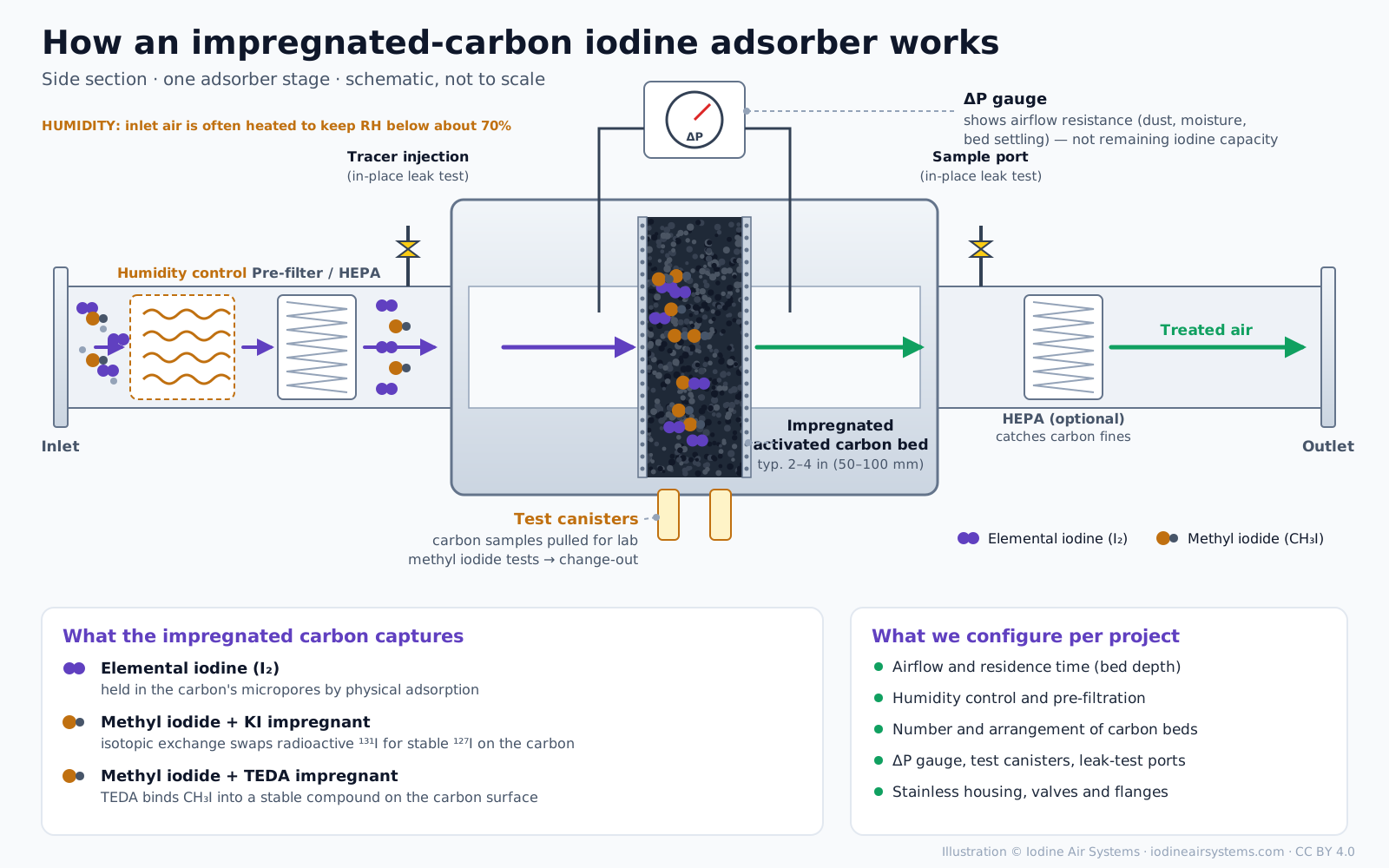
Free to Reuse the Diagram
The adsorber diagram on this page is an original illustration licensed under CC BY 4.0. Use it in training material, articles or presentations with the credit Illustration: Iodine Air Systems (iodineairsystems.com) and a link to this page. Download JPG · Download SVG